The problem is all inside your head she said to me
The answer is easy if you take it logically
I’d like to help you in your struggle to be free
There must be fifty ways to leave your lover.
–Lyrics by Paul Simon
The Euro appears to be a marriage of incompatible partners. A June 1st article in the UK Telegraph titled “Why Europe’s Love Affair with the European Project Is Ending” reported that two-thirds of 9,000 respondents thought that having the euro as their single currency was a mistake.
For Greece, it was a tragic mismatch from the beginning; and like many a breakup, it is really about money. Greece is a vivacious young woman chained to a tyrannical old man. She yearns to be free to dance on her own; but breaking up is hard to do. Defaulting on her debts will force her out of the Eurozone and back to issuing drachmas, and she could get brutally beaten by speculators on foreign exchange markets for her insolence. Continue reading →
The youtube video of 12 year old Victoria Grant speaking at the Public Banking in America conference last month has gone viral, topping a million views on various websites.
Monetary reform—the contention that governments, not banks, should create and lend a nation’s money—has rarely even made the news, so this is a first. Either the times they are a-changin’, or Victoria managed to frame the message in a way that was so simple and clear that even a child could understand it.
According to both the Mayan and Hindu calendars, 2012 (or something very close) marks the transition from an age of darkness, violence and greed to one of enlightenment, justice, and peace. It’s hard to see that change just yet in the events relayed in the major media, but a shift does seem to be happening behind the scenes; and this is particularly true in the once-boring world of banking. Continue reading →
“You will not be able to plug in, turn on and cop out. You will not be able to skip out for beer during commercials. Because the revolution will not be televised. . . . The revolution will be live.”
–From the 1970 hit song by Gil Scott-Heron
Last week, the city of Philadelphia’s school system announced that it expects to close 40 public schools next year, and 64 schools by 2017. The school district expects to lose 40% of its current enrollment, and thousands of experienced, qualified teachers.
But corporate media in other cities made no mention of these massive school closings — nor of those in Chicago, Atlanta, or New York City. Even in the Philadelphia media, the voices of the parents, students and teachers who will suffer were omitted from most accounts.
It’s all about balancing the budgets of cities that have lost revenues from the economic downturn. Supposedly, there is simply no money for the luxury of providing an education for the people.
The Social Security program…represents our commitment as a society to the belief that workers should not live in dread that a disability, death, or old age could leave them or their families destitute.
— President Jimmy Carter, December 20, 1977.
[This law] assures the elderly that America will always keep the promises made in troubled times a half century ago…[The Social Security Amendments of 1983 are] a monument to the spirit of compassion and commitment that unites us as a people.
— President Ronald Reagan, April 20, 1983
So said Presidents Carter and Regan, but that was before 1996, when Congress voted to allow federal agencies to offset portions of Social Security payments to collect debts owed to those agencies. (31 U.S.C. §3716). Now we read of horror stories like this: Continue reading →
The Goldman Sachs coup that failed in America has nearly succeeded in Europe—a permanent, irrevocable, unchallengeable bailout for the banks underwritten by the taxpayers. Continue reading →
‘Cause I live and breathe this Philadelphia freedom
From the day that I was born I’ve waved the flag
Philadelphia freedom took me knee-high to a man
Yeah, gave me peace of mind my daddy never had.
— Elton John, Bernie Taupin, Philadelphia Freedom”
It is well known that Philadelphia was the birthplace of the U.S. Constitution and American democracy. Less well known is that it was also the birthplace of public banking in America. The Philadelphia Quakers originated a banking model involving government-issued money lent to farmers. The profits returned to the government and the people in a sustainable feedback loop that nourished and supported the local economy. Continue reading →
Even the world’s most resource-rich country has now been caught in the debt trap. Its once-proud government programs are being subjected to radical budget cuts—cuts that could have been avoided if the government had not quit borrowing from its own central bank in the 1970s.
The “toxic culture of greed” on Wall Street was highlighted again last week, when Greg Smith went public with his resignation from Goldman Sachs in a scathing oped published in the New York Times. In other recent eyebrow-raisers, LIBOR rates—the benchmark interest rates involved in interest rate swaps—were shown to be manipulated by the banks that would have to pay up; and the objectivity of the ISDA (International Swaps and Derivatives Association) was called into question, when a 50% haircut for creditors was not declared a “default” requiring counterparties to pay on credit default swaps on Greek sovereign debt.
Interest rate swaps are less often in the news than credit default swaps, but they are far more important in terms of revenue, composing fully 82% of the derivatives trade. In February, JP Morgan Chase revealed that it had cleared $1.4 billion in revenue on trading interest rate swaps in 2011, making them one of the bank’s biggest sources of profit. Continue reading →
Once the black sheep of high finance, government owned banks can reassure depositors about the safety of their savings and can help maintain a focus on productive investment in a world in which effective financial regulation remains more of an aspiration than a reality.
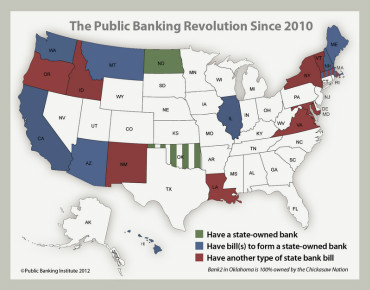
Public sector banking is a concept that is relatively unknown in the United States. Only one state—North Dakota—owns its own bank. North Dakota is also the only state to escape the credit crisis of 2008, sporting a budget surplus every year since; but skeptics write this off to coincidence or other factors. The common perception is that government bureaucrats are bad businessmen. To determine whether government-owned banks are assets or liabilities, then, we need to look farther afield. Continue reading →
Seventeen states have now introduced bills for state-owned banks, and others are in the works. Hawaii’s innovative state bank bill addresses the foreclosure mess. County-owned banks are being proposed that would tackle the housing crisis by exercising the right of eminent domain on abandoned and foreclosed properties. Arizona has a bill that would do this for homeowners who are current in their payments but underwater, allowing them to refinance at fair market value. Continue reading →
In an article titled “Still No End to ‘Too Big to Fail,’” William Greider wrote in The Nation on February 15th:
Financial market cynics have assumed all along that Dodd-Frank did not end “too big to fail” but instead created a charmed circle of protected banks labeled “systemically important” that will not be allowed to fail, no matter how badly they behave.
That may be, but there is one bit of bad behavior that Uncle Sam himself does not have the funds to underwrite: the $32 trillion market in credit default swaps (CDS). Thirty-two trillion dollars is more than twice the U.S. GDP and more than twice the national debt. Continue reading →
A warm invitation is extended to our first annual Public Banking Institute Conference at the Friends Center in Philadelphia, April 27th-28th. More information is here.
A foreclosure settlement between five major banks guilty of “robo-signing” and the attorneys general of the 50 states is pending for Monday, February 6th; but it is still not clear if all the AGs will sign. California was to get over half of the $25 billion in settlement money, and California AG Kamala Harris has withstood pressure to settle.
That is good. She and the other AGs should not sign until a thorough investigation has been conducted. The evidence to date suggests that “robo-signing” was not a mere technical default or sloppy business practice but was part and parcel of a much larger fraud, the fraud that brought down the whole economy in 2008. It is not just distressed homeowners but the entire economy that has paid the price, resulting in massive unemployment and a shrunken tax base, throwing state and local governments into insolvency and forcing austerity measures and cutbacks in government services across the nation. Continue reading →
The Wall Street Journal reported on January 19th that the Obama Administration was pushing heavily to get the 50 state attorneys general to agree to a settlement with five major banks in the “robo-signing” scandal. The scandal involves employees signing names not their own, under titles they did not really have, attesting to the veracity of documents they had not really reviewed. Investigation reveals that it did not just happen occasionally but was an industry-wide practice, dating back to the late 1990s; and that it may have clouded the titles of millions of homes. If the settlement is agreed to, it will let Wall Street bankers off the hook for crimes that would land the rest of us in jail – fraud, forgery, securities violations and tax evasion. Continue reading →
An electronic database called MERS has created defects in the chain of title to over half the homes in America. Counties have been cheated out of millions of dollars in recording fees, and their title records are in hopeless disarray. Meanwhile, foreclosed and abandoned homes are blighting neighborhoods. Straightening out the records and restoring the homes to occupancy is clearly in the public interest, and the burden is on local government to do it. But how? New legal developments are presenting some innovative alternatives. Continue reading →
Neither rain nor sleet nor snow may have stopped the Pony Express, but the nation’s oldest and second largest employer is now under attack. Claiming the Postal Service is bankrupt, critics are pushing legislation that would defuse the postal crisis by breaking the backs of the postal workers’ unions and mandating widespread layoffs. But the “crisis” is an artificial one, created by Congress itself. Continue reading →
The campaign to “move your money” has gotten a groundswell of support. Having greater impact would be to “move our money” — move our local government revenues out of Wall Street banks into our own publicly-owned banks.
On November 27, Bloomberg News reported the results of its successful case to force the Federal Reserve to reveal the lending details of its 2008-09 bank bailout. Bloomberg reported that by March 2009, the Fed had committed $7.77 trillion in below-market loans and guarantees to rescuing the financial system; and that these nearly interest-free loans came without strings attached.
The Fed insisted that the loans were repaid and there have been no losses, but the Bloomberg report said the banks reaped a $13 billion windfall in profits; and “details suggest taxpayers paid a price beyond dollars as the secret funding helped preserve a broken status quo and enabled the biggest banks to grow even bigger.”
The revelations provoked shock and outrage among commentators. But in a letter to the leaders of the House and Senate Committees focused on the financial services industry, Fed Chairman Ben Bernanke responded on December 6th that the figures were greatly exaggerated. Continue reading →
1176. 10-22-23, 10:45 am, speaker, The Weston A. Price Foundation’s 23rd Annual Conference, Kansas City, Missouri.
1175. 10-19-23, The Final Banking Solution, with Simon Thorpe and Colin Maxwell on The Vinny Eastwood Show, YouTube, Australia.
1174. 8-22-23, 10 am, Claremont, CA, Cobb Institute Center for Process, power point presentation: “Restoring Prosperity with a Financial Transaction Tax and Publicly Owned Banks.“ Zoom link is here.
1173. 6-15-23, NIB Zoom town hall, National Infrastructure Bank Coalition.
1172. 5-22-23: Radio interview, 9:30 am est, The Power Hour.
1171. 5-17-23: TV interview, CGTN America, Global Business: “Banking industry in hot seat during Congressional hearings.”
1170. Apr 27, National Infrastructure Bank Coalition webinar, “How to Build the Nation: National Banking vs. Privatization”
1160. 3-16-23, 5 pm pst, National Infrastructure Bank Coalition Town Hall, “Restructuring the American Workforce in a Time of Financial and Economic Turbulence.”
1156. 2-25-23, 15:00-17:00 GMT (Ireland), Think Local Conference 2023, Panel 3 – Money & Economics – New Paradigms
1155. 2-16-23, 5 pm pst, National Infrastructure Bank Coalition, “Washington, Hamilton, Lincoln: National Banking and the Economic Demands of Today’s Crisis,” NIB Zoom Town Hall
1130. Mar. 31, Power Point presentation on youtube, Universidad Nacional de Colombia, Invita: Debates Ensayos de Economia Coordina: Guillermo Maya — Profesor adscrito al Departamento de Economia
1115. Feb. 23, 7 pm est, Eco Justice Collaborative Webinar, “Why the Crises We Face Make Financial Reform Essential,” Religious Society of Friends, Philadelphia
1114. Feb. 17, 11 am, Steff Overbeck, Pod of Gold radio interview
1113. Feb. 18, radio interview, Phil Mikan, wlis1420
1112. Feb. 16, National Infrastructure Bank Coalition Presidents’ Day Webinar 2021 – “National Infrastructure Bank: Standing on the Shoulders of Giants”
1111. Feb. 6, radio interview, Sylvia Richardson, Latin Waves
1097. Oct. 26, Phil Mikan Show, WLIS/WMRD Radio, Conn., pre-recorded for Friday at 10 est or Saturday at 9-11 est
1096. Oct. 22, 1:15 pm EST, power point presentation, “Public Banking, Modern Monetary Theory (MMT) and the National Debt,” Carolina Hills Community, Chapel Hill, NC
1088. July 15, 6 pm EST, Connecticut Public Banking Town Hall, livestream here
1087. July 13, Webinar, Center for Global Justice, “Why Public Banking Needs to Be Run as a Public Utility,” San Miguel de Allende, Mexico, 11am-1pm PDT
1086. Interview with Susan Johnson on public banking for Connecticut, WILI’s Let’s Talk About It Show, 5 pm EST
1044. Nov. 12, interview in New York with Max Keiser, Keiser Report, “Repo Markets and UBI”
1043. Nov. 6, 5 pm EST, The CivicLab Show with Tom Tresser, live@www.facebook.com/tomtree
1042. Oct. 23, 11:30 am-1:30 pm, luncheon presentation on public banking, League of Women Voters of San Diego, Tom Ham’s Lighthouse Restaurant, 2150 Harbor Island Dr., San Diego
1041. Oct. 22, Presentation on public banking, DSA San Diego, Unite Here Union Hall, 2436 Market Street, San Diego, 6-7:30 pm.
1006. Oct. 22, speaker with Gar Alperovitz at Praxis Peace Institute, “Changing the System: California’s Strategic Role in National Strategic Change,” Sonoma, CA, 276 E. Napa St, Sonoma. 7:00 pm.
1005. Oct 19-21, Bioneers Conference, panelist on Oct 20, 2:45 pm, Marin Center, San Rafael, CA.997.
999. Oct. 7, panel, Americans for Democratic Action of Southern California Annual Garden Party, 2-5:30 pm, Santa Monica, CA
998. Oct. 4, 7:30 pm, Living Economy Salon, panelist, Public Bank LA: “Solutions for Social and Environmental Justice”, 3110 Main St., Annex Building C 2nd Floor, Santa Monica, CA 90405
997. Oct. 3, interview on Unmediated, podcast of Reader Magazine, episode title: Making Money The Public’s Slave (The Public Banking Solution), 10 a.m. PT



 WEB OF DEBT BLOG
Greece and the Euro: Fifty Ways to Leave Your Lover
The Euro appears to be a marriage of incompatible partners. A June 1st article in the UK Telegraph titled “Why Europe’s Love Affair with the European Project Is Ending” reported that two-thirds of 9,000 respondents thought that having the euro as their single currency was a mistake.
For Greece, it was a tragic mismatch from the beginning; and like many a breakup, it is really about money. Greece is a vivacious young woman chained to a tyrannical old man. She yearns to be free to dance on her own; but breaking up is hard to do. Defaulting on her debts will force her out of the Eurozone and back to issuing drachmas, and she could get brutally beaten by speculators on foreign exchange markets for her insolence. Continue reading →
Filed under: Ellen Brown Articles/Commentary | 20 Comments »