Posted on August 25, 2013 by Ellen Brown
(Thanks Alex!)
By Alexander Reed Kelly
Every week the Truthdig editorial staff selects a Truthdigger of the Week, a group or person worthy of recognition for speaking truth to power, breaking the story or blowing the whistle. It is not a lifetime achievement award. Rather, we’re looking for newsmakers whose actions in a given week are worth celebrating. Nominate our next Truthdigger here.
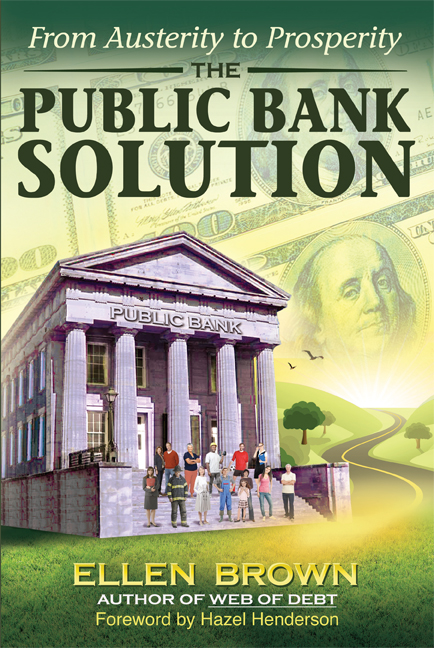
What could happen if we took authority over banking away from Wall Street and gave it to the public? We’re told this is a bad idea—finance is too complex for common people. No doubt this is true. But as events of the last decade have shown, banking in its current form is too complicated even for Harvard-educated “financial wizards” to understand.
Read the full article here.
Filed under: Ellen Brown Articles/Commentary | 1 Comment »
Posted on August 19, 2013 by Ellen Brown
Before Eliot Spitzer’s infamous resignation as governor of New York in March 2008, he was one of our fiercest champions against Wall Street corruption, in a state that had some of the toughest legislation for controlling the banks. It may not be a coincidence that the revelation of his indiscretions with a high-priced call girl came less than a month after he published a bold editorial in the Washington Post titled “Predatory Lenders’ Partner in Crime: How the Bush Administration Stopped the States from Stepping in to Help Consumers.” The editorial exposed the collusion between the Treasury, the Federal Reserve and Wall Street in deregulating the banks in the guise of regulating them, by taking regulatory power away from the states. It was an issue of the federal government versus the states, with the Feds representing the banks and the states representing consumers.
Five years later, Spitzer has set out to take some of that local regulatory power back, in his run for New York City comptroller. Continue reading →
Filed under: Ellen Brown Articles/Commentary | 19 Comments »
Posted on August 5, 2013 by Ellen Brown
The Detroit bankruptcy is looking suspiciously like the bail-in template originated by the G20’s Financial Stability Board in 2011, which exploded on the scene in Cyprus in 2013 and is now becoming the model globally. In Cyprus, the depositors were “bailed in” (stripped of a major portion of their deposits) to re-capitalize the banks. In Detroit, it is the municipal workers who are being bailed in, stripped of a major portion of their pensions to save the banks. Continue reading →
Filed under: Ellen Brown Articles/Commentary | 28 Comments »
Posted on July 29, 2013 by Ellen Brown
When the Occupiers took an interest in moving San Francisco’s money into a city-owned bank in 2011, it was chiefly on principle, in sympathy with the nationwide Move Your Money campaign. But recent scandals have transformed the move from a political statement into a matter of protecting the city’s deposits and reducing its debt burden. The chief roadblock to forming a municipal bank has been the concern that it was not allowed under state law, but a legal opinion issued by Deputy City Attorney Thomas J. Owen has now overcome that obstacle. Continue reading →
Filed under: Ellen Brown Articles/Commentary | 36 Comments »
Posted on July 22, 2013 by Ellen Brown
Rather than expanding the money supply, quantitative easing (QE) has actually caused it to shrink by sucking up the collateral needed by the shadow banking system to create credit. The “failure” of QE has prompted the Bank for International Settlements to urge the Fed to shirk its mandate to pursue full employment, but the sort of QE that could fulfill that mandate has not yet been tried.
Continue reading →
Filed under: Ellen Brown Articles/Commentary | 85 Comments »
Posted on July 5, 2013 by Ellen Brown
A trend to shift responsibility for bank losses onto blameless depositors lets banks gamble away your money.
When Dutch Finance Minister Jeroen Dijsselbloem told reporters on March 13, 2013, that the Cyprus deposit confiscation scheme would be the template for future European bank bailouts, the statement caused so much furor that he had to retract it. But the “bail in” of depositor funds is now being made official EU policy. On June 26, 2013, The New York Times reported that EU finance ministers have agreed on a plan that shifts the responsibility for bank losses from governments to bank investors, creditors and uninsured depositors.
Insured deposits (those under €100,000, or about $130,000) will allegedly be “fully protected.” But protected by whom? The national insurance funds designed to protect them are inadequate to cover another system-wide banking crisis, and the court of the European Free Trade Association ruled in the case of Iceland that the insurance funds were not intended to cover that sort of systemic collapse.
Shifting the burden of a major bank collapse from the blameless taxpayer to the blameless depositor is another case of robbing Peter to pay Paul, while the real perpetrators carry on with their risky, speculative banking schemes. Continue reading →
Filed under: Ellen Brown Articles/Commentary | 115 Comments »
Posted on June 28, 2013 by Ellen Brown
Former Peace Corps volunteer Will Ruddick and several residents of Bangladesh, Kenya, face a potential seven years in prison after developing a cost-effective way to alleviate poverty in Africa’s poorest slums. Their solution: a complementary currency issued and backed by the local community. The Central Bank of Kenya has now initiated charges of forgery.
Complementary currencies can help eradicate poverty.
Proving that may be difficult in complex economies, due to the high number of factors influencing outcomes. But in an African slum with little of the national currency available, supplying residents with an alternative currency has a positive effect that is obvious, immediate and incontrovertible. Continue reading →
Filed under: Ellen Brown Articles/Commentary | 20 Comments »
Posted on June 21, 2013 by Ellen Brown
HUNDREDS GATHER FOR PUBLIC BANKING AND ECONOMIC JUSTICE, by Matt Stannard, June 20, 2013
By any standards, the 2013 Public Banking Conference, held at beautiful Dominican University in San Rafael, California, was a success. In a political world where like-minded groups seldom converge on practical policy blueprints, it was an astounding success. Hundreds of committed attendees–Occupy activists, religious groups, labor, environmentalists, legal activists, journalists and progressive economists–came together for three days of heady conversations and inspiring presentations, and by all accounts, everyone left with something resembling a vision.
Read the whole article here.
Filed under: Ellen Brown Articles/Commentary | 1 Comment »
Posted on June 14, 2013 by Ellen Brown
On July 1, interest rates will double for millions of students – from 3.4% to 6.8% – unless Congress acts; and the legislative fixes on the table are largely just compromises. Only one proposal promises real relief – Sen. Elizabeth Warren’s “Bank on Students Loan Fairness Act.” This bill has been dismissed out of hand as “shameless populist demagoguery” and “a cheap political gimmick,” but is it? Or could Warren’s outside-the-box bill represent the sort of game-changing thinking sorely needed to turn the economy around? Continue reading →
Filed under: Ellen Brown Articles/Commentary | 25 Comments »
Posted on April 29, 2013 by Ellen Brown
“[W]ith Cyprus . . . the game itself changed. By raiding the depositors’ accounts, a major central bank has gone where they would not previously have dared. The Rubicon has been crossed.”
—Eric Sprott, Shree Kargutkar, “Caveat Depositor”
The crossing of the Rubicon into the confiscation of depositor funds was not a one-off emergency measure limited to Cyprus. Similar “bail-in” policies are now appearing in multiple countries. (See my earlier articles here.) What triggered the new rules may have been a series of game-changing events including the refusal of Iceland to bail out its banks and their depositors; Bank of America’s commingling of its ominously risky derivatives arm with its depository arm over the objections of the FDIC; and the fact that most EU banks are now insolvent. A crisis in a major nation such as Spain or Italy could lead to a chain of defaults beyond anyone’s control, and beyond the ability of federal deposit insurance schemes to reimburse depositors.
Continue reading →
Filed under: Ellen Brown Articles/Commentary | 99 Comments »
Posted on April 15, 2013 by Ellen Brown
On April 6, 2013, Ellen Brown of the Public Banking Institute joined Rocky Anderson in a thoughtful discussion relating to the 2008 economic crash and what we can do to protect our state and local economies when Wall Street Banks tank. Fortunately, we have an operating model in North Dakota to learn from: A public state bank.
Listen to the recording below to learn how public state banks save taxpayer dollars and help the economy grow.
Filed under: Ellen Brown Articles/Commentary | 7 Comments »
Posted on April 9, 2013 by Ellen Brown
Cyprus-style confiscation of depositor funds has been called the “new normal.” Bail-in policies are appearing in multiple countries directing failing TBTF banks to convert the funds of “unsecured creditors” into capital; and those creditors, it turns out, include ordinary depositors. Even “secured” creditors, including state and local governments, may be at risk. Derivatives have “super-priority” status in bankruptcy, and Dodd Frank precludes further taxpayer bailouts. In a big derivatives bust, there may be no collateral left for the creditors who are next in line. Continue reading →
Filed under: Ellen Brown Articles/Commentary | 153 Comments »
Posted on March 28, 2013 by Ellen Brown
Confiscating the customer deposits in Cyprus banks, it seems, was not a one-off, desperate idea of a few Eurozone “troika” officials scrambling to salvage their balance sheets. A joint paper by the US Federal Deposit Insurance Corporation and the Bank of England dated December 10, 2012, shows that these plans have been long in the making; that they originated with the G20 Financial Stability Board in Basel, Switzerland (discussed earlier here); and that the result will be to deliver clear title to the banks of depositor funds. Continue reading →
Filed under: Ellen Brown Articles/Commentary | 155 Comments »
Posted on March 21, 2013 by Ellen Brown
If these worries become really serious, . . . [s]mall savers will take their money out of banks and resort to household safes and a shotgun.
— Martin Hutchinson on the attempted EU raid on deposits in Cyprus banks
The deposit confiscation scheme has long been in the making. US depositors could be next . . . .
On Tuesday, March 19, the national legislature of Cyprus overwhelmingly rejected a proposed levy on bank deposits as a condition for a European bailout. Reuters called it “a stunning setback for the 17-nation currency bloc,” but it was a stunning victory for democracy. As Reuters quoted one 65-year-old pensioner, “The voice of the people was heard.”
The EU had warned that it would withhold €10 billion in bailout loans, and the European Central Bank (ECB) had threatened to end emergency lending assistance for distressed Cypriot banks, unless depositors – including small savers – shared the cost of the rescue. In the deal rejected by the legislature, a one-time levy on depositors would be required in return for a bailout of the banking system. Deposits below €100,000 would be subject to a 6.75% levy or “haircut”, while those over €100,000 would have been subject to a 9.99% “fine.”
The move was bold, but the battle isn’t over yet. The EU has now given Cyprus until Monday to raise the billions of euros it needs to clinch an international bailout or face the threatened collapse of its financial system and likely exit from the euro currency zone.
Continue reading →
Filed under: Ellen Brown Articles/Commentary | 166 Comments »
Posted on March 7, 2013 by Ellen Brown
Default on the public debt, nationalization of the banks, and a citizen dividend could actually save the Italian economy.
Comedian Beppe Grillo was surprised himself when his Five Star Movement got 8.7 million votes in the Italian general election of February 24-25th. His movement is now the biggest single party in the chamber of deputies, says The Guardian, which makes him “a kingmaker in a hung parliament.”
Grillo’s is the party of “no.” In a candidacy based on satire, he organized an annual “V Day Celebration,” the “V” standing for vaffanculo (“f—k off”). He rejects the status quo—all the existing parties and their monopoly control of politics, jobs, and financing—and seeks a referendum on all international treaties, including NATO membership, free trade agreements and the Euro.
“If we get into parliament,” says Grillo, “we would bring the old system down, not because we would enjoy doing so but because the system is rotten.” Critics fear, and supporters hope, that if his party succeeds, it could break the Euro system.
Continue reading →
Filed under: Ellen Brown Articles/Commentary | 42 Comments »
Posted on February 24, 2013 by Ellen Brown
Quantitative easing (QE) is supposed to stimulate the economy by adding money to the money supply, increasing demand. But so far, it hasn’t been working. Why not? Because as practiced for the last two decades, QE does not actually increase the circulating money supply. It merely cleans up the toxic balance sheets of banks. A real “helicopter drop” that puts money into the pockets of consumers and businesses has not yet been tried. Why not? Another good question . . . .
When Ben Bernanke gave his famous helicopter money speech to the Japanese in 2002, he was not yet chairman of the Federal Reserve. He said then that the government could easily reverse a deflation, just by printing money and dropping it from helicopters. “The U.S. government has a technology, called a printing press (or, today, its electronic equivalent),” he said, “that allows it to produce as many U.S. dollars as it wishes at essentially no cost.” Later in the speech he discussed “a money-financed tax cut,” which he said was “essentially equivalent to Milton Friedman’s famous ‘helicopter drop’ of money.” Deflation could be cured, said Professor Friedman, simply by dropping money from helicopters.
It seemed logical enough. If the money supply were insufficient for the needs of trade, the solution was to add money to it. Most of the circulating money supply consists of “bank credit” created by banks when they make loans. When old loans are paid off faster than new loans are taken out (as is happening today), the money supply shrinks. The purpose of QE is to reverse this contraction.
But if debt deflation is so easy to fix, then why have the Fed’s massive attempts to pull this maneuver off failed to revive the economy? And why is Japan still suffering from deflation after 20 years of quantitative easing?
Continue reading →
Filed under: Ellen Brown Articles/Commentary | 58 Comments »
Posted on February 13, 2013 by Ellen Brown
As Congress struggles through one budget crisis after another, it is becoming increasingly evident that austerity doesn’t work. We cannot possibly pay off a $16 trillion debt by tightening our belts, slashing public services, and raising taxes. Historically, when the deficit has been reduced, the money supply has been reduced along with it, throwing the economy into recession. After a thorough analysis of statistics from dozens of countries forced to apply austerity plans by the World Bank and IMF, former World Bank chief economist Joseph Stiglitz called austerity plans a “suicide pact.”
Congress already has in its hands the power to solve the nation’s budget challenges – today and permanently. But it has been artificially constrained from using that power by misguided economic dogma, dogma generated by the interests it serves. We have bought into the idea that there is not enough money to feed and house our population, rebuild our roads and bridges, or fund our most important programs — that there is no alternative but to slash budgets and deficits if we are to survive. We have a mountain of critical work to do, improving our schools, rebuilding our infrastructure, pursuing our research goals, and so forth. And with millions of unemployed and underemployed, the people are there to do it. What we don’t have, we are told, is just the money to bring workers and resources together.
But we do have it! Or we could. Continue reading →
Filed under: Ellen Brown Articles/Commentary | 50 Comments »
Posted on February 8, 2013 by Ellen Brown
Restoring public banking is at the top of Hazel Henderson’s list of things to do to build a new financial system. Also prominent is a financial transactions (Tobin) tax, already approved by EU finance ministers.
Read the article here.
Filed under: Ellen Brown Articles/Commentary | 3 Comments »
Posted on January 18, 2013 by Ellen Brown
The trillion dollar coin actually represents one of the most important principles of popular prosperity ever conceived: the creation of money by sovereign governments, debt-free.
Last week on “The Daily Show,” Jon Stewart characterized the proposal that the White House circumvent the debt ceiling by minting a trillion dollar coin as an attempt to “just make shit up.”
Economist and NY Times columnist Paul Krugman responded with a critical blog post accusing Stuart of a “lack of professionalism” for not taking the trillion dollar coin seriously. However, Krugman himself had called the idea “silly.” He thought it was just less silly — and less dangerous — than playing with the debt ceiling, which was itself an unconstitutional shackle on the Treasury’s ability to pay debts already incurred by Congress.
Stewart responded on January 15 that he stood by his “ignorant conclusion that a trillion dollar coin minted to allow the president to circumvent the debt ceiling, however arbitrary that may be, is a stupid f*cking idea.” Continue reading →
Filed under: Ellen Brown Articles/Commentary | 258 Comments »
Posted on January 4, 2013 by Ellen Brown
In a shameless display of putting politics before human needs, Congress began 2013 still scrapping over a $60 billion Hurricane Sandy relief bill fully nine weeks after the disaster hit. And if the Katrina experience is any indication, the bill may not bring adequate relief to struggling and displaced homeowners even when it is finally passed.
The damage wrought by Sandy to New York and New Jersey coastal areas was similar in scale to that to New Orleans from Hurricane Katrina in 2005. Just two weeks after Katrina hit, Congress approved $62.3 billion in emergency appropriations, along with numerous subsequent emergency funding requests to cover the damages, which topped $100 billion. Yet as noted on the Occupy Sandy Facebook page, federal relief funds post-Katrina were gutted in favor of “privatizing and outsourcing relief, making room for predatory lenders, disaster capitalists, and gentrification developers.” Continue reading →
Filed under: Ellen Brown Articles/Commentary | 17 Comments »




 WEB OF DEBT BLOG
Truthdigger of the Week: Ellen Brown
(Thanks Alex!)
By Alexander Reed Kelly
Every week the Truthdig editorial staff selects a Truthdigger of the Week, a group or person worthy of recognition for speaking truth to power, breaking the story or blowing the whistle. It is not a lifetime achievement award. Rather, we’re looking for newsmakers whose actions in a given week are worth celebrating. Nominate our next Truthdigger here.
What could happen if we took authority over banking away from Wall Street and gave it to the public? We’re told this is a bad idea—finance is too complex for common people. No doubt this is true. But as events of the last decade have shown, banking in its current form is too complicated even for Harvard-educated “financial wizards” to understand.
Read the full article here.
Filed under: Ellen Brown Articles/Commentary | 1 Comment »