

http://www.youtube.com/watch?v=-Sp8oREsvW0&feature=uploademail
Filed under: Ellen Brown Articles/Commentary | 11 Comments »
Click to order
Last week I spoke at four events that were televised or videotaped (and one conference that wasn’t). Three of them were on the same day and are now up on youtube. Bad hair day aside, I thought I’d post them here. Speaking at Occupy Wall Street L.A. tomorrow.
Ellen
1. Interview with Stan Emert, Rainmakers.Tv, Seattle, October 26, 2011 (10 youtube segments):
http://www.youtube.com/watch?v=Vp3UI57ZEZA&feature=related
http://www.youtube.com/watch?v=3dUn3ppcsCE&feature=related
http://www.youtube.com/watch?v=8C3DncQkoTI
http://www.youtube.com/watch?v=WsUlnMqL69Y&feature=related
2. Fox News, “Should Students Receive a Bailout?”, October 26, 2011
3. Presentation with Rep. Bob Hasegawa at Kane Hall, Univ of Washington, October 26, 2011
Filed under: Ellen Brown Articles/Commentary | 6 Comments »
Publicly-owned banks were instrumental in funding Germany’s “economic miracle” after the devastation of World War II. Although the German public banks have been targeted in the last decade for takedown by their private competitors, the model remains a viable alternative to the private profiteering being protested on Wall Street today.
Filed under: Ellen Brown Articles/Commentary | 23 Comments »
“Unrestrained financial exploitations have been one of the great causes of our present tragic condition.”
— President Franklin D. Roosevelt, 1933
Why did gold and silver stocks just get hammered, at a time when commodities are considered a safe haven against widespread global uncertainty? The answer, according to Bill Murphy’s newsletter LeMetropoleCafe.com, is that the sector has been the target of massive short selling. For some popular precious metal stocks, close to half the trades have been “phantom” sales by short sellers who did not actually own the stock.
Filed under: Ellen Brown Articles/Commentary | 9 Comments »
AB 750, California’s bill to study the feasibility of establishing a state-owned bank that would receive deposits of state funds, has passed both houses of the legislature and is now on the desk of Governor Jerry Brown awaiting his signature.
Filed under: Ellen Brown Articles/Commentary | 23 Comments »
“War! Good God, ya’ll. What is it good for? Absolutely nothin’!”
So went the anti-Vietnam War protest song popularized by Edwin Starr in 1970 and revived by Bruce Springsteen in the 1980s.
The song echoed popular sentiment. The Vietnam War ended. Then the Cold War ended. Yet military spending remains the government’s number one expenditure. When veterans’ benefits and other past military costs are factored in, half the government’s budget now goes to the military/industrial complex.
After 9/11, the pop hit “War” was placed on the list of post-9/11 inappropriate titles distributed by Clear Channel.
Protesters have been trying to stop the military juggernaut ever since the end of World War II, yet the war machine is more powerful and influential than ever. Why?
Read the full article here.
Filed under: Ellen Brown Articles/Commentary | 3 Comments »
North Dakota has had the nation’s lowest unemployment ever since the economy tanked. What’s its secret?
Filed under: Ellen Brown Articles/Commentary | 11 Comments »
What just happened in the stock market? Last week, the Dow Jones Industrial Average rose or fell by at least 400 points for four straight days, a stock market first.
The worst drop was on Monday, 8-8-11, when the Dow plunged 624 points. Monday was the first day of trading after US Treasury bonds were downgraded from AAA to AA+ by Standard and Poor’s.
Filed under: Ellen Brown Articles/Commentary | 32 Comments »
It used to be that when the Fed Chairman spoke, the market listened; but the Chairman has lost his mystique. Now when the market speaks, politicians listen. Hopefully they heard what the market just said: government cutbacks are bad for business. The government needs to spend more, not less. Fortunately, there are viable ways to do this while still balancing the budget.
Read more here.
Filed under: Ellen Brown Articles/Commentary | 9 Comments »
The debt ceiling crisis can be averted by enforcing the Fourteenth Amendment, which mandates the government to pay its debts already incurred, including pensions. That means Social Security, which IS an “entitlement,” in the original sense of the word. We’re entitled to it because we’ve paid for it with taxes.
The game of Russian roulette being played with the U.S. federal debt has been called a “grotesque political carnival” and political blackmail. The uproar stems from a statute that is unique to the United States and never did make much sense. First passed in 1917 and revised multiple times since, it imposes a dollar limit on the federal debt. What doesn’t make sense is that the same Congress that voted on the statute votes on the budget, which periodically exceeds the limit, requiring the statute to be revised. The debt ceiling has been raised 74 times since 1962, 10 of them since 2001. The most recent increase, to $14.294 trillion by H.J.Res. 45, was signed into law on February 12, 2010.
Taxes aren’t collected until after the annual budget is passed, so Congress can’t know in advance whether or how much additional borrowing will be required. Inevitably, there will be some years that the budget pushes the debt over the limit, requiring new legislation. And inevitably, now that this tactic has been discovered, there will be a costly battle over the increase, wasting congressional time, destabilizing markets, and rattling faith in the American financial and political systems. There will be continual blackmail, arm-twisting and concessions. The situation is untenable and cries out for a definitive resolution.
Fortunately, there is one . . .
Read more here.
Filed under: Ellen Brown Articles/Commentary | 4 Comments »
Why aren’t banks lending to local businesses? The Fed’s decision to pay interest on $1.6 trillion in “excess” reserves is a chief suspect.
Where did all the jobs go? Small and medium-sized businesses are the major source of new job creation, and they are not hiring. Startup businesses, which contribute a fifth of the nation’s new jobs, often can’t even get off the ground. Why?
Filed under: Ellen Brown Articles/Commentary | 21 Comments »
On June 30, QE2 ended with a whimper. The Fed’s second round of “quantitative easing” involved $600 billion created with a computer keystroke for the purchase of long-term government bonds. But the government never actually got the money, which went straight into the reserve accounts of banks, where it still sits today. Worse, it went into the reserve accounts of FOREIGN banks, on which the Federal Reserve is now paying 0.25% interest.
Read the complete article here.
Filed under: Ellen Brown Articles/Commentary | 7 Comments »
Wall Street banks have cut back on small business lending… [by] more than double the cutback in overall lending.… [Small business] options just keep disappearing.
–Elizabeth Warren, Chair of the TARP Congressional Oversight Panel
The Wall Street bailout of 2008 has radically altered the banking business. The bailout was supposed to keep credit flowing to Main Street, but it has wound up having the opposite effect. Small and medium-sized businesses have traditionally been the main engines for increasing employment, and they need bank credit for their working capital; but today credit to local businesses has collapsed nearly everywhere.
That’s why so many states—the total is now fourteen—are considering turning to state-owned banks to get local credit flowing again.
Read more here.
Filed under: Ellen Brown Articles/Commentary | 6 Comments »
The military is the nation’s largest and most firmly entrenched entitlement program, one that takes half of every tax dollar.
Filed under: Ellen Brown Articles/Commentary | 3 Comments »
Countries everywhere are facing debt crises today, precipitated by the credit collapse of 2008. Public services are being slashed and public assets are being sold off, in a futile attempt to balance budgets that can’t be balanced because the money supply itself has shrunk. Governments usually get the blame for excessive spending, but governments did not initiate the crisis. The collapse was in the banking system, and in the credit that it is responsible for creating and sustaining . . . .
Read more here.
Filed under: Ellen Brown Articles/Commentary | 5 Comments »
Last week, the Federal Reserve Bank of Boston (FRBB) released a report titled “The Bank of North Dakota: A Model for Massachusetts and Other States?” The report confirms that the Bank of North Dakota (BND) is a prudent, well-managed financial institution that serves in partnership with community banks as an effective economic backstop to credit contractions. . . .
Read more here.
Filed under: Ellen Brown Articles/Commentary | 6 Comments »
[T]hreatening to default should not be a partisan issue. In view of all the hazards it entails, one wonders why any responsible person would even flirt with the idea.
— Alan S. Blinder, Princeton professor of economics, former vice chairman of the Federal Reserve
A game of Russian roulette is being played with the national debt ceiling. Fire the wrong chamber of the gun, and the result could be the second Great Depression. Continue reading
Filed under: Ellen Brown Articles/Commentary | 8 Comments »
California is the eighth largest economy in the world, and it has a debt burden to match. It has outstanding general obligation bonds and revenue bonds of $158 billion, largely incurred for infrastructure. Of this tab, $70 billion is just for interest. Over $7 billion of California’s annual budget goes to pay interest on the state’s debt.
Filed under: Ellen Brown Articles/Commentary | 14 Comments »
Debate continues to rage between the inflationists who say the money supply is increasing, dangerously devaluing the currency, and the deflationists who say we need more money in the economy to stimulate productivity. The debate is not just an academic one, since the Fed’s monetary policy turns on it and so does Congressional budget policy.
Filed under: Ellen Brown Articles/Commentary | 26 Comments »
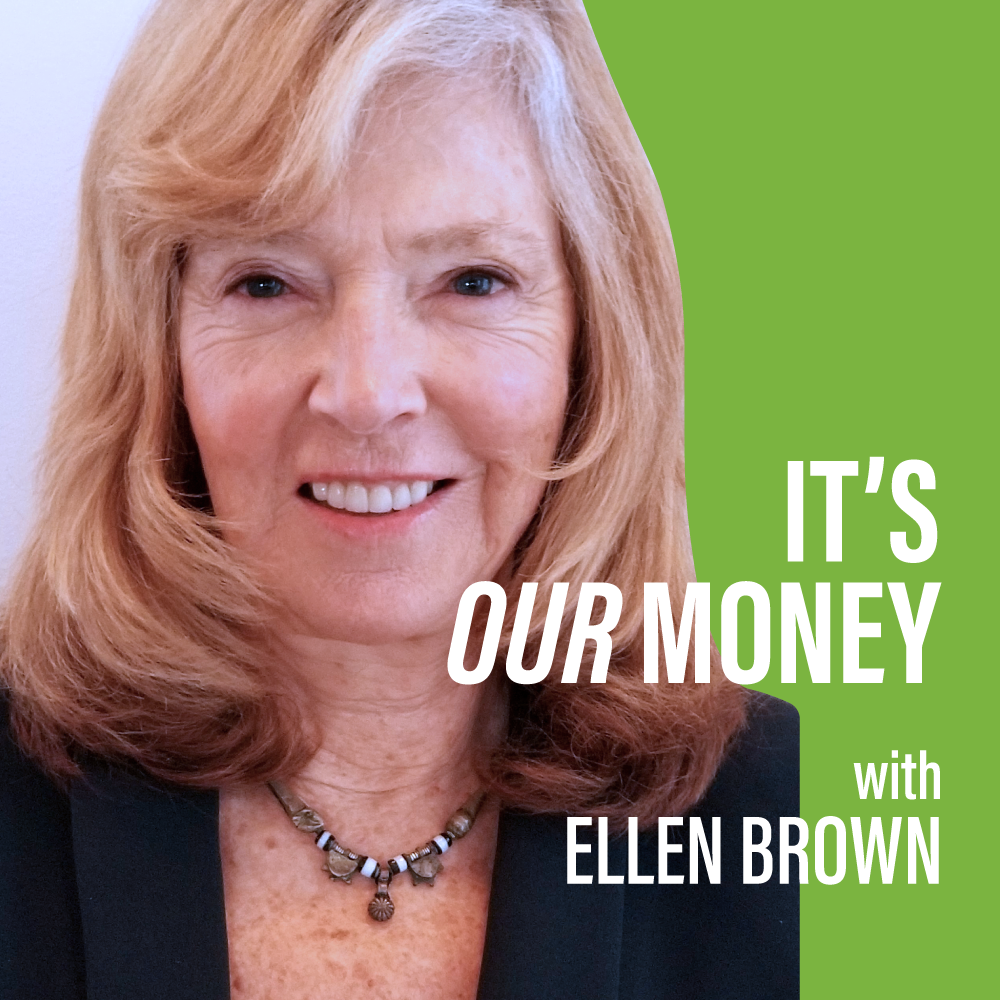
PRN.FM Radio Show, 3pm EST Wednesdays. Click image for archives.
 WEB OF DEBT BLOG
TIME FOR AN ECONOMIC BILL OF RIGHTS
Henry Ford said, “It is well enough that the people of the nation do not understand our banking and monetary system, for if they did, I believe there would be a revolution before tomorrow morning.”
We are beginning to understand, and Occupy Wall Street looks like the beginning of the revolution.
Read full article here.
Filed under: Ellen Brown Articles/Commentary | 10 Comments »