Northern Rock Nationalized

In England, the government does not bail out bankrupt banks without some quid pro quo; it takes their stock . . .

LONDON – Britain’s treasury chief Alistair Darling said today that struggling bank Northern Rock PLC will be nationalized.

That after the government rejected two takeover bids.

Northern Rock ran into trouble in September because it relied too heavily on short-term money markets instead of deposits for funding.
http://ca.news.finance.yahoo.com/s/17022008/2/biz-finance-britain-nationalize-troubled-mortgage-lender-northern-rock.html

View from the Titanic — in the news the week of 1-21-08

Chalmers Johnson, “How To Sink America”

http://www.rense.com/general80/sink.htm

_______________

Bill Engdahl, “The Financial Tsunami Part III: Greenspan’s Grand Design”

http://www.financialsense.com/editorials/engdahl/2008/0123.html

______________

“Housing prices to free fall in 2008”

http://money.cnn.com/2008/01/23/real_estate/merrill_forecast/index.htm?

______________ 

“A tipping point? ‘Foreclose me … I’ll save money’”

http://latimesblogs.latimes.com/laland/2008/01/a-tipping-point.html

______________ 

George Soros, “The worst market crisis in 60 years”

http://www.ft.com/cms/s/0/24f73610-c91e-11dc-9807-000077b07658.html

_______________

Rick Ackerman, “PPT emerges from the shadows”

http://news.goldseek.com/RickAckerman/1201071660.php

More banking woes: the lawsuits begin

CLEVELAND SUES 21 BANKS OVER SUBPRIME MESS

by Henry J. Gomez and Thomas Ott, January 11, 2008

Mayor Frank Jackson took aim at Wall Street on Thursday with a lawsuit against 21 major investment banks that he said have enabled the subprime lending and foreclosure crisis here.

The one-of-a-kind suit, filed in Cuyahoga County Common Pleas Court, accuses venerable institutions such as Deutsche Bank, Goldman Sachs, Merrill Lynch and Wells Fargo of creating a public nuisance.

Jackson contends the companies irresponsibly bought and sold high-interest home loans. The result: widespread defaults that depleted the city’s tax base and left entire neighborhoods in ruins.

. . . “To me, this is no different than organized crime or drugs,” Jackson said in an interview with Plain Dealer reporters and editors.

“It has the same effect as drug activity in neighborhoods. It’s a form of organized crime that happens to be legal in many respects.”

. . . Cleveland is the second major U.S. city this week to sue over the ills of subprime loans.

On Tuesday, Baltimore sued Wells Fargo, alleging the bank intentionally sold high-interest mortgages more to blacks than to whites – a violation of federal law.

The Baltimore and Cleveland efforts are believed to be the first attempts by large cities to recover losses blamed on the foreclosure epidemic, which has particularly plagued Ohio. . . .

http://www.cleveland.com/news/plaindealer/index.ssf?/base/cuyahoga/1200044068184570.xml&coll=2

After the collapse – a short story

An entry below titled “Up to $6.5 trillion in mortgage-backed securities may be in jeopardy.  Subprime borrowers may have an escape hatch — no paperwork providing standing to sue!”, got this response from short story writer Philip Zack:

The situation inspired me to write a short story called “As Is” about life after the collapse. It starts like this…

Ryan Svorlin stood in front of the big house, gaping. The keys hung loosely in his shaking hand, clattering against one another in rhythmic reflection of the waves of shock coursing through his troubled mind. “It… it’s… mine,” he stammered, unable to comprehend what had just happened.

“Well, sure,” the real estate lady told him. “You did sign the papers, didn’t you?”

He slowly turned to look at her. Paper-thin skin stretched across unnaturally prominent cheekbones. Overdone make-up. Probably over seventy, he guessed. “Of course. But I never expected to —.”

“To be selected? Well, someone had to be. They couldn’t afford to let these places go vacant, after all.”

Less than a year had passed since the first cannonade in the financial meltdown destroyed the façade of normalcy masquerading as prosperity in the United States. Some faceless blogger had instigated a mortgage strike, an incautious response to the revelation that the reason the government was so determined to protect the masses from being dispossessed in their forced insolvency was the dirtiest little secret at the heart of the country’s high-flying economy – that nobody really owned all those high-risk loans, and therefore the houses could not be foreclosed. No one could have predicted what happened next.

Read the whole thing here:
http://klurgsheld.wordpress.com/2007/12/18/short-story-as-is/

The “Real Bills” Doctrine: A Modern Application?

A blogger named Syzygy just wrote this comment to the entry called “Why Not Gold?” below.  The query was about the “real bills” doctrine, but I’ll quote the whole thing, as it was nice! —   

“Am one-third through your book now.  Of the hundreds of non-fiction books I’ve read, yours easily deserves a place in the top ten.  Astonishingly well done and important.

“As for this Fekete/Hultberg stuff, I don’t understand a word of it.  Will you please post your understanding of it on your site?

“I confess I’m pretty skeptical of gold/silver standards; what’s to stop foreign creditors from simply sucking out all the specie?  If the Saudis, Chinese, and Japanese could exchange their declining US dollars for gold and silver bullion, wouldn’t they do that in an instant?” 

                                                                 — Syzygy

 Thanks Syzygy.  I agree that gold would just be vacuumed out by dollar-holding foreigners.  That’s exactly what happened before 1971, when Nixon finally closed the “gold window” to preserve what little gold was left at Fort Knox.   Fekete and Hultberg propose fixing the gold system by supplementing gold with “Real Bills” as was done in the 19th century.  (See Hultberg, “The Future of Gold as Money,” Gold-Eagle.com, February 1, 2005.)  I’m currently doing a book revision (to be available hopefully in early January) that contains a brief discussion of the Real Bills Doctrine, which I’ll post it here:

The “Real Bills” Doctrine

If using gold as a currency is plagued with so many problems, why did it work reasonably well right up to World War I?  Nelson Hultberg and Antal Fekete argue that gold was able to function as a currency because it was supplemented with a private money system called “real bills” – short-term bills of exchange that traded among merchants as if they were money.  Real bills were invoices for goods and services that were passed from hand to hand until they came due, serving as a secondary form of money that was independent of the banks and allowed the money supply to expand without losing its value.8 

The “real bills” doctrine was postulated by Adam Smith in The Wealth of Nations in 1776.  It held that so long as money is issued only for assets of equal value, the money will maintain its value no matter how much is issued.  If the issuer takes in $100 worth of silver and issues $100 worth of paper money in exchange, the money will hold its value since it can be cashed in for the silver.  Likewise, if the issuer takes I.O.U.s for $100 worth of corn in the future and issues $100 worth of paper money in exchange, the money will hold its value, since the issuer can sell the corn in the market and get its money back.  Or if the issuer takes a mortgage on a gambler’s house in exchange for issuing $100 and lending it to the gambler, the money will hold its value even if the gambler loses the money in the market, since the issuer can sell the house and get its money back. 

Professor Fekete observes that the real bills system works to preserve monetary value only when there is gold to be collected at the end of the exchange, but other commodities would obviously work as well.  One alternative that has been proposed is the “Kilowatt Card,” a privately-issued paper currency that can be traded as money or cashed in for units of electricity.10  The nineteenth century Greenbackers relied on the “real bills” doctrine when they contended that the money supply would retain its value if the government issued paper dollars in exchange for labor that produced an equivalent value in goods and services.  The real bills doctrine was rejected by twentieth century economists in favor of the quantity theory of money, but it is actually the basis on which the Federal Reserve advances credit today: it takes mortgage-backed loans as collateral, then “monetizes” them by advancing an equivalent sum in accounting-entry dollars to the borrowing bank.9 

——-

That was what I had written, but in response to Syzygy’s question, I too don’t understand how adding “real bills” would allow a modern-day gold standard to work any better than it did in the 19th century, when it precipitated periodic serious depressions.  Why not just use the “real bills” and skip the gold?  Roosevelt took the dollar off the gold standard domestically for the same reason Nixon took it off internationally: people were cashing in their dollars for gold, draining gold reserves and collapsing the supply of paper dollars, which in 1933 were backed by 40 percent gold reserves.  That meant that whenever two paper dollars were cashed in for gold, three other paper dollars issued as loans had to be called in as well.  If Roosevelt had let it go on, the money supply could eventually have collapsed completely.

What I like about the real bills doctrine, though, is that it defines the difference between money created out of nothing just to pay off loans to banks (the sort of loans being madly extended right now by central banks in an effort to bail out commercial banks) and Greenback-style money issued  as receipts for real goods and services (as Lincoln and the Guernsey Islanders did it).  The latter was “backed” by something; supply balanced demand, so no inflation resulted.  The Fed/central bank version is HIGHLY inflationary, because it pumps ever more “demand” into the system without creating anything productive to balance it in the way of “supply.”   

More evidence that the banking system is on the verge of collapse

Subprime is just the tip of the iceberg.  The banks are concealing bad loans Enron style . . .

http://www.counterpunch.org/martens12072007.html

“ON THE CUSP OF A MAMMOTH FINANCIAL CRISIS.  AT STAKE IS NOTHING LESS THAN THE CONTINUED EXISTENCE OF THE U.S. BANKING SYSTEM.”

http://www.sfgate.com/cgi-bin/article.cgi?f=/c/a/2007/12/09/IN5BTNJ2V.DTL  

Up to $6.5 trillion in mortgage-backed securities debt may be in jeopardy. Subprime borrowers may have an escape hatch — no paperwork providing standing to sue!

A federal judge in Ohio has ruled that a Deutsche Bank trust failed to show standing to foreclose on 14 mortgages held as mortgage-backed securities, since it hadn’t produced original assignments from the mortgagors.  The problem is, original assignments may not actually exist.  Signed hard copies are required to foreclose, and the original signed mortgages have been left in a file somewhere, while the mortgages have been slice and diced and rehypothecated until no single investor or pool can prove ownership.  If the mortgage-backed securities holders don’t hold enforceable mortgage notes, who does?  Arguably nobody!  Think of the fallout if ALL these defaulted subprime mortgages can’t be foreclosed on.  Outstanding securitized mortgage debt now comes to $6.5 trillion.  Once borrowers catch on, they may not bother to pay their mortgages even if they can; there’s no one with standing to foreclose!

Gretchen Morgenson, “Foreclosures Hit a Snag for Lenders,” New York Times, November 15, 2007

http://www.nytimes.com/2007/11/15/business/15lend.html

U.S. banking system headed for bankruptcy?

The SIV superfund bailout resembles the accounting fraud in Enron, and it’s liable to end just as badly for the banks . . . .  

 Jim Willie, “Deadly Dollar Confluence,” 11-8-07 

http://www.financialsense.com/fsu/editorials/willie/2007/1108.html

“The banking distress is nowhere near ended, steadily denied as almost fixed, yet every passing week it seems yet another new remedy bailout rescue package feature . . . . The recent Structured Investment Vehicle (SIV) superfund testifies to the breadth of rescues. This one smells to high heaven as an illicit balance sheet redemption, at inflated unrealistic prices to boot, for the specific benefit of connected insider Wall Street firms. The Citigroup, Merrill Lynch, and Morgan Stanley forced admission of losses is not a mere accounting issue, without cash being involved. They are gigantic investment losses that the cute SIV device could not avoid in hitting the balance sheets. All eyes have turned to balance sheet accounting gimmicks, otherwise called fraud. The truth might be that losses are twice what are admitted, maybe worse. . . . The total will inexorably march to $2 trillion, and that figure might be conservative. Do not expect foreigners to pick up that tab. It will be financed by the US$ printing press, weighing down the US Dollar.”

See also Charles Hughes Smith, “Empire of Debt I: The Great Unraveling Begins,” November 5, 2007 —
http://www.oftwominds.com/blognov07/empire-debt1.html

Latest articles

BEHIND THE DRUMS OF WAR WITH IRAN:
NUCLEAR WEAPONS OR COMPOUND INTEREST?
November 9, 2007
http://www.webofdebt.com/articles/war-with-iran.php

Update – more economic sanctions on Iran –
http://www.guardian.co.uk/usa/story/0,,2208176,00.html

LETTER TO THE UNITED NATIONS:
HOW TO CUT SUSTAINABLE ENERGY COSTS IN HALF
November 5, 2007
http://www.webofdebt.com/articles/energy-costs.php

The Fed bails out SIVs with conjured money

Excellent article explaining the SIV crisis:

“SIV-Positive,” by Eric J. Fry, October 26, 2007

http://www.agorafinancial.com/afrude/ 

Fry writes:

Since almost all the investors who comprise the free market refuse to purchase ABCP [asset-backed commercial paper], the Federal Reserve has stepped into the breach. . . .

Could the Fed conjure up $1 trillion worth of AB financing between now and President’s Day, 2008? Maybe, but probably not without also conjuring up a dollar crisis, or a bond market crisis…or both at once. The only viable path toward recovery and normalcy requires a legitimate mark-to-market. But marking MBS and CDOs to real-world prices might clip tens of billions of dollars from bank balance sheets…and might kick a few dozen millionaire-bankers to the curb.

Unfortunately, because the millionaire-bankers still control the flow of information – and still hold meetings with the Treasury Secretary to concoct shell games – the “fantasy pricing” regime remains in effect.

Why not gold?

I’ve received many comments on returning to gold as the national medium of exchange.  Here’s my short answer on why I think it’s an insufficient solution:

A dollar lent at 10 percent interest compounded annually becomes 10 dollars in under 25 years.  That means that if the money supply were 100 percent gold, and if bankers lent out 10 percent of it at 10 percent interest compounded annually, in 25 years the bankers would own all the gold.  To avoid that, either the money supply has to be expandable — which means allowing fiat money — or the taking of interest has to be outlawed, as it was in the Middle Ages.

The banking shell game: “spreading risk” turns to contagion

Here is an excellent article explaining how the derivatives scheme, which “spread the risk” in a way that was supposed to protect investors, has actually spread credit risk like a contagion, infecting everything it touches. 

“Financial Shell Games” by Satyajit Das, New Delhi, September 16, 2007

http://www.business-standard.com/common/storypage_c.php?leftnm=10&autono=298108

Smoke and mirrors: concealing economic collapse with the shock of war?

“Soup Kitchen USA” by Mike Whitney, September 11, 2007http://www.informationclearinghouse.info/article18360.htm 

“It’s all smoke and mirrors. The financial system has decoupled from the productive elements of the economy and is now beginning to show disturbing signs of instability. That’s why the big blow-off in the bond market. The halcyon days of supplying our armies, funding our markets and building our subprime ‘ownership society’ empire on the backs of foreign creditors is over. The stock market is headed for the landfill and housing is leading the way. Economic fundamentals can only be ignored for so long . . . .”

At the end of this article,Whitney discusses one from the UK Telegraph (9-9-07) titled “Banks Face 10-day Debt Time Bomb”:

http://www.telegraph.co.uk/money/main.jhtml?xml=/money/2007/09/09/cndebt109.xml

To which one blogger ominously observes:
In the article above, it notes that
UK banks are in serious trouble of having to cough up a boatload of cash between 9/11 and 9/19. 9/14 lies smack in the middle of this. Could another false flag attack be used as some type of distraction? Most of the SEC evidence against World Com, Enron and others was lost in the WTC complex on 9/11/01. Is there a target in America that will serve the same purpose this time around? It seems the global financial system is in the process of imploding. We need to quickly identify how an attack might thwart it, or maybe make it look like it was the attack rather than bad monetary and fiscal policy that caused the economy to tank world wide. Would this just be an attack, an ‘accident’ or the sum of all fears – an errant nuke detonation used to justify a limited and orchestrated nuclear exchange between West and East? If the global monetary system is about to result in open worldwide revolution, and you were responsible, wouldn’t you try to make it look like something else was the cause? (and take out a few of the ‘masses’ in the process?) Remember, most military action in any nation is the direct result of flawed domestic policy or weak leaders, most notably relating to the economy. Now imagine that on a world wide scale.

http://www.freemarketnews.com/WorldNews.asp?nid=48646&fb=1

See also “The Shock Doctrine,” a must-see film by Alfonso Cuarón and Naomi Klein, demonstrating how “free market” economists pioneered the concept of “shock” to push through whatever draconion economic policies they desired on unsuspecting populations recovering from major disasters:

http://www.naomiklein.org/shock-doctrine/short-film

What’s the Wizard of Oz got to do with money reform?

I just found a 12-page blog entry by “thx1138” that summarizes my book and what it all means so well that I’m copying the first 2 pages here.  (That may be copyright infringement, but here’s my defense: most of it came from my book!)  Thanks for your insights on my insights, thx1138!  I’ve read everything I could find on the subject and digested it and put it into my best prose; but the next reader who sees it fresh then sees even more ramifications.  My brilliant friendly editors played that role too.  It’s a group effort.  Anyone else with fresh insights is invited to post them at the right under the new blog section titled “Join in the Debate!”  I should add, because someone just brought it up, that Thx1138 and his commenters seem to have an issue with race, and I prefer to avoid that issue.  (You notice how I’m not even naming the race?)  I don’t think you can blame a whole race for anything in history; it’s always a few bad apples twisting the purposes of the race.  Even if it’s a leader with a whole army of followers, it still isn’t the “race” that did it.  Anyway it’s not my issue.  I’m just delving into the system, how it works, what went wrong, and how we can fix it.  So here’s the post: 

THE WIZARD OF OZ REVISITED by thx1138

http://www.wakeupfromyourslumber.com/node/3408 

I’ll get to the “Wizard of Oz” reference in a moment. It’s a bit of history I did not know before.

First, you already know that private bankers own mankind. You know they create money on a computer screen. Take their power away, but leave them the power to create money, and with the touch of a button they will create enough money to buy the earth back again.

You know that bankers create principal, but not the interest to service their loans. To find the interest, new loans must continually be taken out. This expands the money supply, increases prices, and robs you of the value of your money. Thus, private bankers ultimately rule through inflation, (ever-increasng debt) which makes you run faster and faster on a treadmill owned by the private bankers. Eventually you must drop.

You also know that the government does not create money (except for coins). The Federal Reserve creates money and lends it to us. Every dollar in your hand is a debt note to private bankers. And since we all use money, we all play with debt (negative capital) whether we like it or not. If we ended the private banking cartel, the federal debt could be paid, income taxes could be eliminated, and social programs could be expanded — all without imposing austerity measures or sparking runaway inflation. This is not utopian. It has been done many times in history, starting with ancient Rome.

The International Banker is like the Wizard of Oz, standing behind the curtain of policymakers and “elected” leaders. Behind the curtain is a little old man, playing with lights and loudspeakers.

THE WIZARD OF OZ

Frank Baum wrote his Wizard of Oz books at the turn of the century, when the money question was still a hotly debated issue. His Oz books were an allegory for our tyrannical money system. Example: In the 1890s, the private bankers did not yet own all the media sources. Therefore everyone was concerned with how money should be created. Should the government create it with full accountability to the people — or should private banks create it in secret? After the Jekyl Island meeting in 1910, the latter option won. World War I and the Great Depression sealed the private banks’ power. We have been enslaved ever since. (Those who think “enslaved” is an exaggeration do not understand the game.)

William Jennings Bryan, the Populist candidate for President in 1896 and again in 1900, mounted the last serious challenge to the private bankers. In The Wonderful Wizard of Oz (1900) Frank Baum used the cowardly lion to represent William Jennings Bryan. In the 1900 book (not the 1939 movie) the Lion finally proves he is the King of Beasts by decapitating a giant spider that terrorizes everyone in the forest. The giant spider was the Morgan/Rockefeller banking cartel, which William Jennings Bryan opposed.

The scarecrow represented farmers, who did not understand how the bankers were screwing them. The tin man represented industrial laborers who were desperate for lubricant (currency). Dorothy is the average American girl. The yellow brick road was the gold standard, which led to the Emerald City (Washington or, alternately, New York’s financial district). The wizard is the U.S. President, who in the book is terrified of the evil witches. The “wicked witch of the east” was the eastern financial establishment. The “wicked witch of the west” was the western bankers (at that time ensconced in Ohio). The “good witch of the north” was the people. The munchkins were the generally enslaved, who live in terror of the evil witches (the bankers). And so on.

ALTERNATIVES

Before World War I, two opposing systems of political economy competed for dominance in the United States. One was the New York financial district, which came to symbolize American finance. Its most important address was 23 Wall Street, known as the “House of Morgan.” Mr. J. P. Morgan was an agent of private Jewish banking interests. Since private financiers controlled the gold, they established a national currency based on the “gold standard.” Today the gold standard has been eliminated, and the global economy is based on funny money. This allows an increase of debt as never before in world history.

The other system dated back to Benjamin Franklin. It operated out of Philadelphia, which was the USA’s first capitol before the capitol was moved to Washington. At one of the Constitutional Conventions, Franklin’s “Society for Political Inquiries” planned an economy that would free us from economic slavery to England. In response, England sent troops to enforce the private Jewish bankers’ power, thus sparking the War Of Independence. The Philadelphia faction favored a bank on a model established in provincial Pennsylvania. In this model, a state office issued or lent money, collected the interest, and returned it to the provincial government to be used in place of taxes. President Lincoln returned to the colonial system of government-issued money during the Civil War, but the bankers assassinated him and reclaimed control of the money machine.

As you know, the bankers’ power was finally sealed by the Federal Reserve Act of 1913, plus the Income Tax Act, World War I, and the Great Depression. Private banks deliberately caused all these disasters. Today the average person assumes that government (not private bankers) creates money. Therefore everyone thinks inflation is caused by an out-of-control government running the dollar printing presses. In reality, inflation is caused by private bankers issuing loans. As noted above, every dollar they create is a loan we must pay back to the bankers with interest. About 97% of our currency is not coins or bills. It exists only in the computers of private central banks. The interest on the U.S. government’s $9 trillion debt will soon be more than the taxpayers can afford to pay. When taxpayers can’t pay it, the economy will collapse. Then private bankers will launch World War III. Economists are paid to chatter about nothing. Their lies conceal the power of the private bankers. Economics needs lightening up with imagery, metaphors, characters, and a plot.

REGARDING MY SOURCES

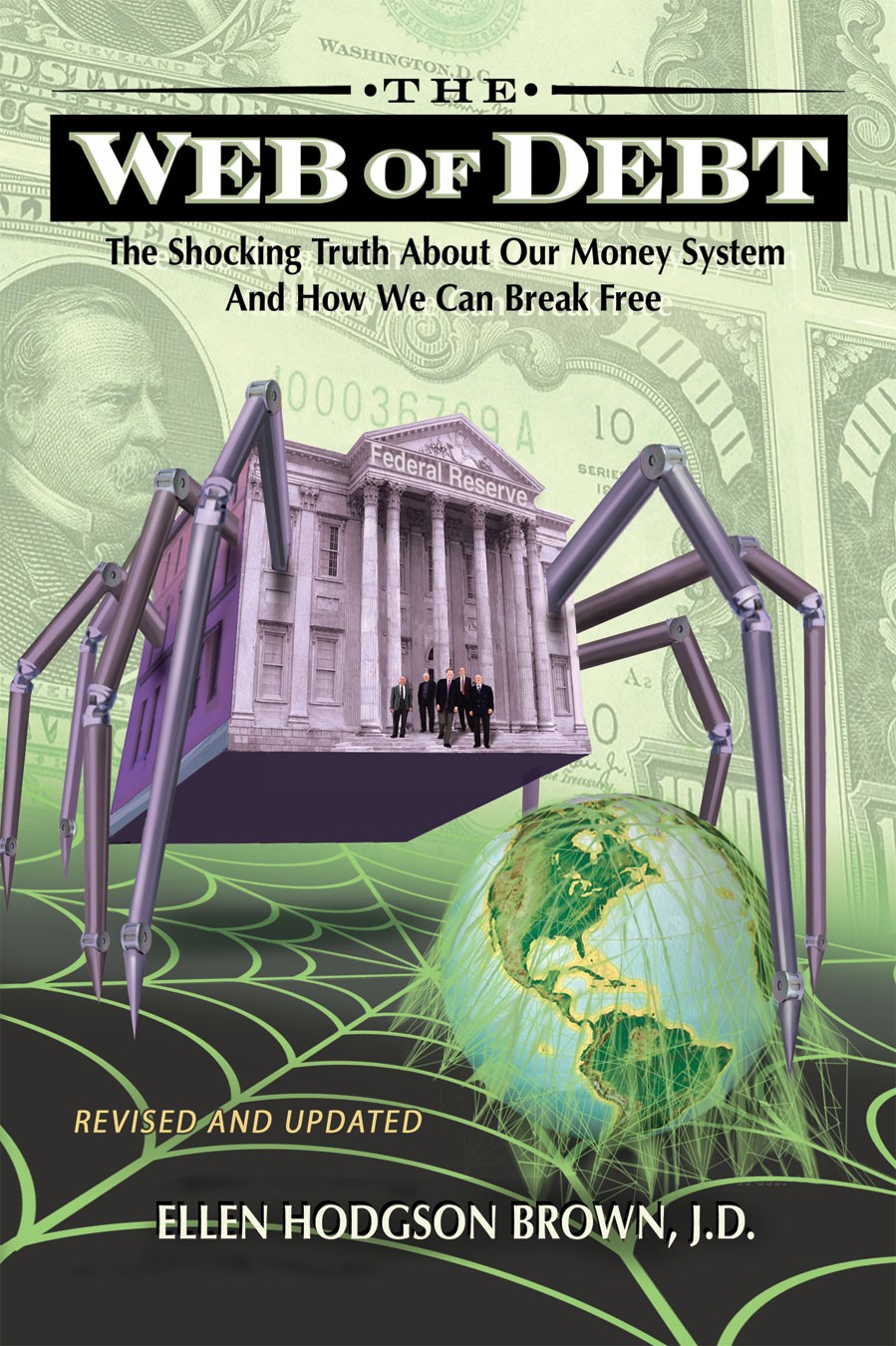
Ellen Hodgson Brown, a brilliant attorney in Los Angeles, has written a book titled Web of Debt, which dissects and exposes the entire game. I saw the book at rense.com. Much of what she says you already know about, but there is much information I did not know, such as the Wizard of Oz books being an allegory for the tyranny of private bankers. Ms. Brown explains how and why the bankers deliberately sparked the illegal alien invasion, for example. She also includes numerous quotes from central bankers who explain (in their own words) how the game is played.

I encourage you to troll around Ms. Brown’s web site. http://www.webofdebt.com/  Also be sure to check out her blog at https://webofdebt.wordpress.com/ . She has a lot of juicy stuff. She also says (correctly) that history must be completely re-written so we know the truth. Her analysis of Nazi Germany and the island of Guernsey (an independent nation off the coast of England) are major eye-openers. Miracles are possible if we just take back control of our money and follow the U.S. Constitution.You absolutely must read her “Dollar Deception: How Banks Secretly Create Money.” Ms. Brown explains how one American man legally defeated the banks, which wanted to foreclose on the man’s property. Since banks crate money out of thin air, there is no “consideration.” Hence all contracts with banks are null.  

http://www.webofdebt.com/articles/dollar-deception.php

You will also learn why there is a wave of illegal immigration from Mexico to the USA. Mexico is suffering from a depression, caused by private bankers (Goldman Sachs etc.) that stole billions from Mexico’s reserves. This wiped out almost all the jobs in Mexico, despite the fact that Mexico has plenty of oil. (See “The Tequila Trap.”)

Meltdown: stock market in free fall

Mike Kosares: THE MORNING AFTER THE OPEN-ENDED BAILOUT (August 11, 2007)

This time it IS different.

In past financial bailouts, the destruction was limited to one or two institutions. A group was put together in the private sector, or the central bank stepped in, and the troubled entity was bailed out.

When the Federal Reserve, the European Central Bank, and Bank of Japan moved last week to bail out the entire financial industry worldwide, they offered, as the Financial Times pointed out today, the equivalent of a credit card with no credit limit and subsidized rates 1 or 2 percent below what would have been the free-market rate had they not stepped in.

What’s more, it was done on a global basis to the tune of hundreds of billions in “liquidity.”

Thus the central banks have set a dangerous precedent . . . .

http://www.gata.org/node/5347

Iran wants yen, not dollars

Iran Wants Yen from Japan not the U.S. $ for Oil  

At the heart of the global monetary system lies the use of the U.S.$ as the currency used to pay for the globe’s oil. Any change in that role has a disproportionate impact on the importance of the $ as well as its value relative to the globe’s other currencies. . . . So when we heard that Iran asked the Japanese refiners to switch to the Yen to pay for all crude oil purchases, after Iran’s central bank said it is reducing its holdings of the U.S.$, we realized that this is an undermining blow to the $ and will also contribute to the current fall of the $ in exchange rate values, despite any short-term rally. . . .

http://news.goldseek.com/GoldForecaster/1185591600.php

_________________

Iran Asks Japan to Pay Yen for Oil (7-13-07)

“Iran isn’t alone in wanting to drop the dollar for pricing oil. Russia has been examining plans to price the Urals oil export blend in rubles to curb currency risks . . . .”

http://www.bloomberg.com/apps/news?pid=20670001&refer=worldwide&sid=aLaColVYu5LA

Tax challenge

IRS Loses Challenge to Prove Tax Liability 

 by Bob Unruh, World Net Daily (July 26, 2007)

The IRS has lost a lawyer’s challenge in front of a jury to prove a constitutional foundation for the nation’s income tax, and the victorious attorney now is setting his sights higher. “I think now people are beginning to realize that this has got to be the largest fraud, backed up by intimidation and extortion and by the sheer force of taking peoples property and hard-earned money without any lawful authorization whatsoever,” lawyer Tom Cryer told WND just days after a jury in Louisiana acquitted him of two criminal tax counts . . . .

http://www.worldnetdaily.com/news/article.asp?ARTICLE_ID=56855

Bill Bonner, “Fed Speak for Dummies” (7-19-07)

“Money that is created ‘out of thin air’ – courtesy of central banks and financial firms – tends to go back from whence it came. For every genesis of wealth creation…there is an exodus of wealth destruction. Watch out for it…”

http://www.dailyreckoning.com/Issues/2007/DR071907.html

Exposing the bugs beneath the rocks . . .

“Credit crunch will ‘shred investment portfolios to ribbons'” by Ambrose Evans-Pritchard, Telegraph U.K., July 2, 2007           

“The near collapse of two Bear Stearns hedge funds has lifted the rock on our 21st century mutant capitalism, exposing the bugs beneath to a rare shock of naked light. . . . If you think we are too clever now to let a full-blown slump occur, read the BIS report.   “Virtually nobody foresaw the Great Depression of the 1930s, or the crises which affected Japan and south-east Asia in the early and late 1990s. In fact, each downturn was preceded by a period of non-inflationary growth exuberant enough to lead many commentators to suggest that a ‘new era’ had arrived,” it said.. . . So the oldest and most venerable global watchdog is worried enough to evoke the dangers of depression. It will not happen. Fed chief Ben Bernanke . . . will slash rates to zero if necessary, and then – in his own words – drop cash from helicopters. But his solution is somebody else’s dollar crisis. . . . Perhaps governments should simply stop trying to rig the price of money in the first place.”

http://www.telegraph.co.uk/money/main.jhtml?xml=/money/2007/07/02/bcncrunch102.xml

Signs of collapse: in the news April & May ’07

Mike Whitney, “Housing Bubble Meltdown: Is It Too Late to Get Out?”,  April 28, 2007

http://www.marketoracle.co.uk/Article882.html 

“The details of the meltdown are being downplayed in the media to prevent panic-selling among the public. But the Fed knows what’s going on. . . .

“Kenneth Heebner, manager of CGM Realty Fund (Capital Growth Management), provided a realistic forecast of what we can expect in the near future as defaults increase. . . . “I would expect that housing prices in 2007 will decline 20% in a lot of markets. What you are going to see is the greatest price decline in housing since the Great Depression . . . .

“Nearly 70% of subprimes have been securitized [sold as securities to hedge funds and institutional investors]. . . . In Henry C K Liu’s “Why the Subprime Bust will Spread” (Asia Times) the author states that the bursting housing bubble will trigger a major pension crisis. After all, who are the “institutional investors? They are mostly pension funds that manage the money the US working public depends on for retirement. . . .” (Liu)

“. . . Since nearly 50% of “securitized” mortgage debt is owned by foreign investors, the subprime meltdown is bound send tremors through the entire global financial system.”
___________________________________________________________ 

“The Housing Mess” by Terry Savage, The Street.com 5-13-07

http://www.thestreet.com/_iwon/newsanalysis/opinion/10356410.html?cf=WSIWON1111051500

Predicts a drop in home prices of 30 to 50 percent.  Other sources warn that a drop in home prices of 40 percent would collapse the economy of the United States.  (See Web of Debt, chapter  31.)  Collapsed mortgages and foreclosures shrink the supply of money-built-on-debt, shrinking the economy, in the sort of syndrome experienced in the Great Depression.

____________________________________________________________

“Venezuela Exits IMF and World Bank,” AlJazeera.net, May 1, 2007.

http://english.aljazeera.net/NR/exeres/A9912111-2F84-46E8-AF39-5FFD33332E29.htm

Details how Venezuela and other countries are distancing themselves from international lenders.

Related article: “Chavez Threatens to Nationalize Banks, Steel Producer,” Associated Press (May 3, 2007)

http://biz.yahoo.com/ap/070503/venezuela_chavez.html?.v=19

_______________________________________________________

“Asia Will Start Its Own Currency Pool So It Can Dump IMF,” drawing on Bloomberg News Service article dated May 3, 2007.

http://www.gata.org/node/5042

________________________________________________________

Emily Thornton, “Roads to Riches – Why investors are clamoring to take over America’s highways, bridges, and airports – and why the public should be nervous,” Business Week, May 7, 2007.

http://www.businessweek.com/magazine/content/07_19/b4033001.htm?chan=search

_________________________________________________________________________