

Filed under: video | Tagged: Federal Reserve, public banking, repo madness, repo market crisis | 1 Comment »
Click to order
Filed under: video | Tagged: Federal Reserve, public banking, repo madness, repo market crisis | 1 Comment »
Former Federal Reserve Chairman Alan Greenspan called Paul Volcker “the most effective chairman in the history of the Federal Reserve.” But while Volcker, who passed away Dec. 8 at age 92, probably did have the greatest historical impact of any Fed chairman, his legacy is, at best, controversial.
“He restored credibility to the Federal Reserve at a time it had been greatly diminished,” wrote his biographer, William Silber. Volcker’s policies led to what was called “the New Keynesian revolution,” putting the Fed in charge of controlling the amount of money available to consumers and businesses by manipulating the federal funds rate (the interest rate at which banks borrow from each other). All this was because Volcker’s “shock therapy” of the early 1980s – raising the federal funds rate to an unheard of 20% – was credited with reversing the stagflation of the 1970s. But did it? Or was something else going on?
Less discussed was Volcker’s role at the behest of President Richard Nixon in taking the dollar off the gold standard, which he called “the single most important event of his career.” He evidently intended for another form of stable exchange system to replace the Bretton Woods system it destroyed, but that did not happen. Instead, freeing the dollar from gold unleashed an unaccountable central banking system that went wild printing money for the benefit of private Wall Street and London financial interests. Continue reading
Filed under: Ellen Brown Articles/Commentary | Tagged: Alan Greenspan, fed funds rate, Federal Reserve, Federal Reserve policy, Inflation, Paul Volcker, public banking, recession, shock therapy, stagflation | 5 Comments »
Interest in public banking is high! I just finished a run of 11 presentations and in-person interviews in 7 cities in 10 weeks. Here’s a video from one, a debate with a county official sponsored by the League of Women Voters in San Diego, and two power points from another, the Soil and Nutrition Conference in Southbridge, MA.
Power point, A Deep Dive into Money and Banking, Soil & Nutrition Conf 11-19
Power point, Funding the Green Transition, Soil & Nutrition Conf 11-19
Filed under: video | Tagged: Bank of North Dakota, Cal. AB 857, Federal Reserve, Green New Deal, People's QE, public banking, regenerative agriculture | 8 Comments »
What’s going on in the repo market? Rates on repurchase agreements (“repo”) should be around 2%, in line with the fed funds rate. But they shot up to over 5% on September 16 and got as high as 10% on September 17. Yet banks were refusing to lend to each other, evidently passing up big profits to hold onto their cash – just as they did in the housing market crash and Great Recession of 2008-09.
Since banks weren’t lending, the Federal Reserve Bank of New York jumped in, increasing its overnight repo operations to $75 billion; and on October 23 it upped the ante to $120 billion in overnight operations and $45 billion in longer-term operations.
Why are banks no longer lending to each other? Are they afraid that collapse is imminent somewhere in the system, as with the Lehman collapse in 2008?
Perhaps, and if so the likely suspect is Deutsche Bank. But it looks to be just another case of Wall Street fattening itself at the public trough, using the funds of mom and pop depositors to maximize bank profits and line the pockets of bank executives while depriving small businesses of affordable loans. Continue reading
Filed under: Ellen Brown Articles/Commentary | Tagged: Federal Reserve, lehman brothers, public banking, QE, quantitative easing, repo market, repurchase agreements | 4 Comments »
This 10-page paper was written for the Economics of Happiness Conference co-sponsored by Local Futures, held in Jeonju, Korea, on October 16-17, where I was the keynote speaker — a wonderful city and great experience!

Satisfaction in the workplace is a major component of the “happiness” index; but it is a satisfaction that young people joining the workforce today are not feeling. In a 2017 book titled Kids These Days: Human Capital and the Making of Millennials, Malcolm Harris asks why the millennial generation – those born between 1981 and 1996 – are so burned out. His answer is, “the economy.” Millennials are bearing the brunt of the economic damage wrought by late 20th century capitalism, with economic insecurities throwing them into a state of perpetual panic. Harris argues that if they want to meaningfully improve their lives and the lives of future generations, they will have to overthrow the system and rewrite the social contract.
A similar crisis of capitalism is being faced by millennials in South Korea, which has been ranked near the bottom of the OECD’s “Better Life Index.”[1] Warabel, meaning “work-life balance,” is a new term for an old movement that began in South Korea in the 1970s, after a 22-year-old workers’ rights activist committed suicide by setting himself ablaze in protest over the poor working conditions in South Korean factories. His death brought attention to the substandard labor conditions and helped the formation of a labor union movement in South Korea.[2]
Today Korean millennials are protesting in other ways. Continue reading
Filed under: Ellen Brown Articles/Commentary | Tagged: Economics of Happiness, Korean economic miracle, public banking, South Korean economy | 5 Comments »
President Trump wants negative interest rates, but they would be disastrous for the U.S. economy, and his objectives can be better achieved by other means.
The dollar strengthened against the euro in August, merely in anticipation of the European Central Bank slashing its key interest rate further into negative territory. Investors were fleeing into the dollar, prompting President Trump to tweet on Aug. 30:
The Euro is dropping against the Dollar “like crazy,” giving them a big export and manufacturing advantage… And the Fed does NOTHING!
When the ECB cut its key rate as anticipated, from a negative 0.4% to a negative 0.5%, the president tweeted on Sept. 11:
The Federal Reserve should get our interest rates down to ZERO, or less, and we should then start to refinance our debt. INTEREST COST COULD BE BROUGHT WAY DOWN, while at the same time substantially lengthening the term.
And on Sept. 12 he tweeted:
European Central Bank, acting quickly, Cuts Rates 10 Basis Points. They are trying, and succeeding, in depreciating the Euro against the VERY strong Dollar, hurting U.S. exports…. And the Fed sits, and sits, and sits. They get paid to borrow money, while we are paying interest!
However, negative interest rates have not been shown to stimulate the economies that have tried them, and they would wreak havoc on the U.S. economy, for reasons unique to the U.S. dollar. The ECB has not gone to negative interest rates to gain an export advantage. It is to keep the European Union from falling apart, something that could happen if the United Kingdom does indeed pull out and Italy follows suit, as it has threatened to do. If what Trump wants is cheap borrowing rates for the U.S. federal government, there is a safer and easier way to get them. Continue reading
Filed under: Ellen Brown Articles/Commentary | Tagged: bail-in, bailout, derivatives, Donald Trump, EU, European Central Bank, Federal Reserve, Jay Powell, money market, negative interest rates, public banking | 5 Comments »
Conceding that their grip on the economy is slipping, central bankers are proposing a radical economic reset that would shift yet more power from government to themselves.
Central bankers are acknowledging that they are out of ammunition. Mark Carney, the soon-to-be-retiring head of the Bank of England, said in a speech at the annual meeting of central bankers in August in Jackson Hole, Wyoming, “In the longer-term, we need to change the game.” The same point was made by Philipp Hildebrand, former head of the Swiss National Bank, in an August 2019 interview with Bloomberg. “Really there is little if any ammunition left,” he said. “More of the same in terms of monetary policy is unlikely to be an appropriate response if we get into a recession or sharp downturn.” Continue reading
Filed under: Ellen Brown Articles/Commentary | Tagged: central banks, economics, Ellen Brown, Federal Reserve, helicopter money, IMF, Mark Carney, Nationalize the Fed, public banking | 20 Comments »
We are again reaching the point in the business cycle known as “peak debt,” when debts have compounded to the point that their cumulative total cannot be paid. Student debt, credit card debt, auto loans, business debt and sovereign debt are all higher than they have ever been. As economist Michael Hudson writes in his provocative 2018 book, “…and forgive them their debts,” debts that can’t be paid won’t be paid. The question, he says, is how they won’t be paid.
Mainstream economic models leave this problem to “the invisible hand of the market,” assuming trends will self-correct over time. But while the market may indeed correct, it does so at the expense of the debtors, who become progressively poorer as the rich become richer. Borrowers go bankrupt and banks foreclose on the collateral, dispossessing the debtors of their homes and their livelihoods. The houses are bought by the rich at distress prices and are rented back at inflated prices to the debtors, who are then forced into wage peonage to survive. When the banks themselves go bankrupt, the government bails them out. Thus the market corrects, but not without government intervention. That intervention just comes at the end of the cycle to rescue the creditors, whose ability to buy politicians gives them the upper hand. According to free-market apologists, this is a natural cycle akin to the weather, which dates all the way back to the birth of modern economics in ancient Greece and Rome.
Hudson counters that those classical societies are not actually where our financial system began, and that capitalism did not evolve from bartering, as its ideologues assert. Rather, it devolved from a more functional, sophisticated, egalitarian credit system that was sustained for two millennia in ancient Mesopotamia (now parts of Iraq, Turkey, Kuwait and Iran). Money, banking, accounting and modern business enterprise originated not with gold and private trade, but in the public sector of Sumer’s palaces and temples in the third millennium B.C. Because it involved credit issued by the local government rather than private loans of gold, bad debts could be periodically forgiven rather than compounding until they took the whole system down, a critical feature that allowed for its remarkable longevity. Continue reading
Filed under: Ellen Brown Articles/Commentary | Tagged: Babylonian captivity, debt jubilee, history of money and banking, national dividend, public banking, Sumerian cuneiform writings, Universal basic income | 30 Comments »
When the Federal Reserve cut interest rates on July 31st for the first time in more than a decade, commentators were asking why. According to official data, the economy was rebounding, unemployment was below 4%, and GDP growth was above 3%. If anything, by the Fed’s own reasoning, it should have been raising rates.
The explanation of market pundits was that we’re in a trade war and a currency war. Other central banks were cutting their rates and the Fed had to follow suit, in order to prevent the dollar from becoming overvalued relative to other currencies. The theory is that a cheaper dollar will make American products more attractive on foreign markets, helping our manufacturing and labor bases.
Over the weekend, President Trump followed the rate cuts by threatening to impose a new 10% tariff on $300 billion worth of Chinese products effective September 1st. China responded by suspending imports of U.S. agricultural products by state-owned companies and letting the value of the yuan drop. On Monday, August 5, the Dow Jones Industrial Average dropped nearly 770 points, its worst day in 2019. The war was on.
The problem with a currency war is that it is a war without winners. This was demonstrated in the beggar-thy-neighbor policies of the 1930s, which just prolonged the Great Depression. Continue reading
Filed under: Ellen Brown Articles/Commentary | Tagged: currency war, free markets, International Monetary Fund, neoliberal economic policies, public banking, trade war | 26 Comments »
Planting billions of trees across the world is by far the cheapest and most efficient way to tackle the climate crisis. So states a July 4 article in The Guardian, citing a new analysis published in the journal Science. The author explains:
As trees grow, they absorb and store the carbon dioxide emissions that are driving global heating. New research estimates that a worldwide planting programme could remove two-thirds of all the emissions that have been pumped into the atmosphere by human activities, a figure the scientists describe as “mind-blowing”.
For skeptics who reject the global warming thesis, reforestation also addresses the critical problems of mass species extinction and environmental pollution, which are well documented. A 2012 study from the University of Michigan found that loss of biodiversity impacts ecosystems as much as climate change and pollution. Forests shelter plant and animal life in their diverse forms, and trees remove air pollution by the interception of particulate matter on plant surfaces and the absorption of gaseous pollutants through the leaves. Continue reading
Filed under: Ellen Brown Articles/Commentary | Tagged: biodiversity, carbon sequestration, Green New Deal, hemp, pollution, public banking, reforestationo | 18 Comments »
The Democratic Party has clearly swung to the progressive left, with candidates in the first round of presidential debates coming up with one program after another to help the poor, the disadvantaged and the struggling middle class. Proposals ranged from a Universal Basic Income to Medicare for All to a Green New Deal to student debt forgiveness and free college tuition. The problem, as Stuart Varney observed on FOX Business, was that no one had a viable way to pay for it all without raising taxes or taking from other programs, a hard sell to voters. If robbing Peter to pay Paul is the only alternative, the proposals will go the way of Trump’s trillion dollar infrastructure bill for lack of funding.
Fortunately there is another alternative, one that no one seems to be talking about – at least no one on the presidential candidates’ stage. In Japan, it is a hot topic; and in China, it is evidently taken for granted: the government can generate the money it needs simply by creating it on the books of its own banks. Leaders in China and Japan recognize that stimulating the economy is not a zero-sum game in which funds are just shuffled from one pot to another. To grow the economy and increase GDP, demand (money) must go up along with supply. New money needs to be added to the system; and that is what China and Japan have been doing, very successfully. Continue reading
Filed under: Ellen Brown Articles/Commentary | Tagged: Abenomics, Chinese economy, Democratic debates, economic stimulus, public banking, quantitative easing | 47 Comments »
Payments can happen cheaply and easily without banks or credit card companies. This has now been demonstrated – not in the United States but in China. Unlike in the US, where numerous firms feast on fees from handling and processing payments, in China most money flows through mobile phones nearly for free. In 2018 these cashless payments totaled a whopping $41.5 trillion; and 90% were through Alipay and WeChat Pay, a pair of digital ecosystems that blend social media, commerce and banking. According to a May 2018 article in Bloomberg titled “Why China’s Payment Apps Give U.S. Bankers Nightmares”:
The nightmare for the U.S. financial industry is that a technology company—whether from China or a homegrown juggernaut such as Amazon.com Inc. or Facebook Inc.—replicates the success of Alipay and WeChat in America. The stakes are enormous, potentially carving away billions of dollars in annual revenue from major banks and other firms.
That threat may now be materializing. On June 18, Facebook unveiled a white paper outlining ambitious plans to create a new global cryptocurrency called Libra, to be launched in 2020. The New York Times says Facebook has high hopes that Libra will become the foundation for a new financial system free of control by Wall Street power brokers and central banks. Continue reading
Filed under: Ellen Brown Articles/Commentary | Tagged: central banks, digital currencies, Facebook, Libra, public banking | 16 Comments »
Home ownership has been called “the quintessential American dream.” Yet today less than 65% of American homes are owner occupied, and more than 50% of the equity in those homes is owned by the banks. Compare China, where, despite facing one of the most expensive real estate markets in the world, a whopping 90% of families can afford to own their homes.
Over the last decade, American wages have stagnated and U.S. productivity has consistently been outpaced by China’s. The U.S. government has responded by engaging in a trade war and imposing stiff tariffs in order to penalize China for what the White House deems unfair trade practices. China’s industries are said to be propped up by the state and to have significantly lower labor costs, allowing them to dump cheap products on the U.S. market, causing prices to fall and forcing U.S. companies out of business. The message to middle America is that Chinese labor costs are low because their workers are being exploited in slave-like conditions at poverty-level wages.
But if that’s true, how is it that the great majority of Chinese families own homes? According to a March 2016 article in Forbes:
… 90% of families in the country own their home, giving China one of the highest home ownership rates in the world. What’s more is that 80% of these homes are owned outright, without mortgages or any other liens. On top of this, north of 20% of urban households own more than one home.
Filed under: Ellen Brown Articles/Commentary | Tagged: Chinese economy, home ownership, public banking, quantitative easing | 19 Comments »
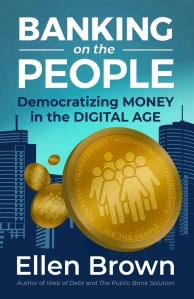
This article is excerpted from my new book Banking on the People: Democratizing Money in the Digital Age, available in paperback June 1.
The U.S. federal debt has more than doubled since the 2008 financial crisis, shooting up from $9.4 trillion in mid-2008 to over $22 trillion in April 2019. The debt is never paid off. The government just keeps paying the interest on it, and interest rates are rising.
In 2018, the Fed announced plans to raise rates by 2020 to “normal” levels — a fed funds target of 3.375 percent — and to sell about $1.5 trillion in federal securities at the rate of $50 billion monthly, further growing the mountain of federal debt on the market. When the Fed holds government securities, it returns the interest to the government after deducting its costs; but the private buyers of these securities will be pocketing the interest, adding to the taxpayers’ bill.
In fact it is the interest, not the debt itself, that is the problem with a burgeoning federal debt. The principal just gets rolled over from year to year. But the interest must be paid to private bondholders annually by the taxpayers and constitutes one of the biggest items in the federal budget. Currently the Fed’s plans for “quantitative tightening” are on hold; but assuming it follows through with them, projections are that by 2027 U.S. taxpayers will owe $1 trillion annually just in interest on the federal debt. That is enough to fund President Donald Trump’s trillion-dollar infrastructure plan every year, and it is a direct transfer of wealth from the middle class to the wealthy investors holding most of the bonds.
Where will this money come from? Crippling taxes, wholesale privatization of public assets, and elimination of social services will not be sufficient to cover the bill. Continue reading
Filed under: Ellen Brown Articles/Commentary | Tagged: federal debt, Federal Reserve, modern monetary theory, public banking | 41 Comments »
From the back cover:
Today most of our money is created, not by governments, but by banks when they make loans. This book takes the reader step by step through the sausage factory of modern money creation, explores improvements made possible by advances in digital technology, and proposes upgrades that could transform our outmoded nineteenth century system into one that is democratic, sustainable, and serves the needs of the twenty-first century.
Banking on the People is a compelling and fast-moving primer on the new monetary revolution by the godmother of the public banking movement now emerging throughout the country. Brown shows how our new understanding of money and its creation, long concealed by bankers and others capturing the benefits for their own purposes, can be turned to support the public in powerful new ways.
— Gar Alperovitz, professor emeritus at the University of Maryland, Co-Founder of The Democracy Collaborative and author of America Beyond Capitalism and other books
More lucidly that any other expert I know, Ellen Brown shows in Banking on the People how we can break the grip of predatory financialization now extracting value from real peoples’ productive activities all over the world. This book is a must read for those who see the promising future as we seek to widen democracies and transform to a cleaner, greener, shared prosperity.
— Hazel Henderson, CEO of Ethical Markets Media and author of Mapping the Global Transition to the Solar Age and other books
Ellen Brown shows that there is a much better alternative to Citibank, Wells Fargo and Bank of America. Public banks can safeguard public funds while avoiding the payday loans, redlining, predatory junk-mortgage loans and add-on small-print extras for which the large commercial banks are becoming notorious.
— Michael Hudson, Research Professor of Economics at the University of Missouri, Kansas City, and author of Killing the Host and other books
Banking on the People offers a tour de force for those activists, NGOs, and academics wanting to understand the forces at play when we talk about the democratization of finance. A must read!
— Thomas Marois, Senior Lecturer, SOAS University of London, author of States, Banks and Crisis and other publications
Filed under: Ellen Brown Articles/Commentary | Tagged: public banking | 17 Comments »
As public banking gains momentum across the country, policymakers in California and Washington state are vying to form the nation’s second state-owned bank, following in the footsteps of the highly successful Bank of North Dakota, founded in 1919. The race is close, with state bank bills now passing their first round of hearings in both states’ senates.
In California, the story begins in 2011, when then-Assemblyman Ben Hueso filed his first bill to explore the creation of a state bank. The bill, which was for a blue-ribbon committee to do a feasibility study, sailed through both legislative houses and seemed to be a go. That is, until Gov. Jerry Brown vetoed it, not on grounds that he disapproved of the concept, but because he said we did not need another blue-ribbon committee. The state had a banking committee that could review the matter in-house. Needless to say, nothing was heard of the proposal after that.
So when now-Sen. Hueso filed SB 528 earlier this year, he went straight for setting up a state bank. The details could be worked out during the two to three years it would take to get a master account from the Federal Reserve, by a commission drawn from in-house staff that had access to the data and understood the issues.
Sen. Hueso also went for the low hanging fruit—a proposal to turn an existing state institution, the California Infrastructure and Development Bank (or “IBank”), into a depository bank that could leverage its capital into multiple loans. Continue reading
Filed under: Ellen Brown Articles/Commentary | Tagged: Bank of North Dakota, California Infrastructure and Development Bank, public banking, Washington State Investment Trust | 20 Comments »
“If you invest your tuppence wisely in the bank, safe and sound,
Soon that tuppence safely invested in the bank will compound,“And you’ll achieve that sense of conquest as your affluence expands
In the hands of the directors who invest as propriety demands.”— Mary Poppins, 1964
When Mary Poppins was made into a movie in 1964, Mr. Banks’ advice to his son was sound. Banks were then paying more than 5% interest on deposits, enough to double young Michael’s investment every 14 years.
Now, however, the average savings account pays only 0.10% annually – that’s 1/10th of 1% – and many of the country’s biggest banks pay less than that. If you were to put $5,000 in a regular Bank of America savings account (paying 0.01%) today, in a year you would have collected only 50 cents in interest.
That’s true for most of us, but banks themselves are earning 2.4% on their deposits at the Federal Reserve. Continue reading
Filed under: Ellen Brown Articles/Commentary | Tagged: Federal Reserve, interest on deposits, IOER, negative interest, postal banking, public banking | 9 Comments »
As alarm bells sound over the advancing destruction of the environment, a variety of Green New Deal proposals have appeared in the US and Europe, along with some interesting academic debates about how to fund them. Monetary policy, normally relegated to obscure academic tomes and bureaucratic meetings behind closed doors, has suddenly taken center stage.
The 14 page proposal for a Green New Deal submitted to the US House of Representatives by Congresswoman Alexandria Ocasio Cortez does not actually mention Modern Monetary Theory, but that is th it’s e approach currently capturing the attention of the media – and taking most of the heat. The concept is good: abundance can be ours without worrying about taxes or debt, at least until we hit full productive capacity. But the devil is in the details…. Continue reading
Filed under: Ellen Brown Articles/Commentary | Tagged: Green New Deal, MMT, public banks, QE | 34 Comments »
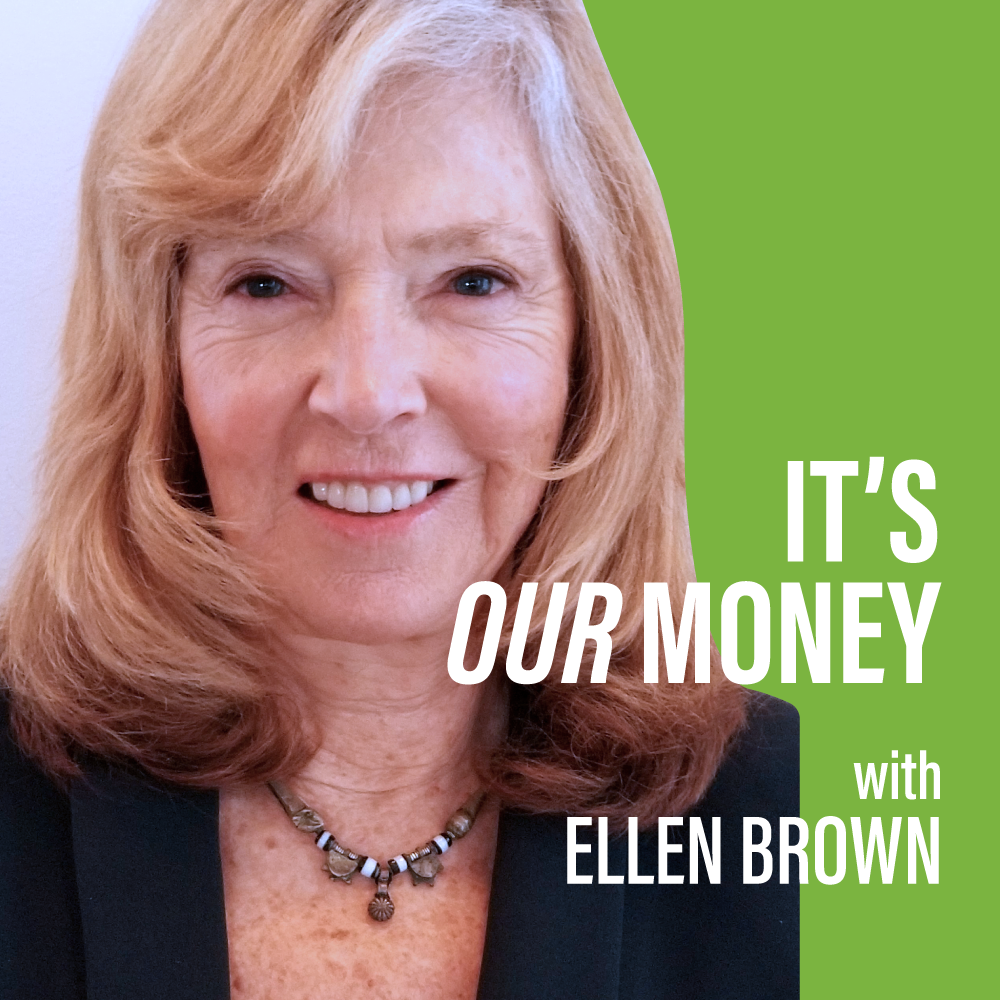
PRN.FM Radio Show, 3pm EST Wednesdays. Click image for archives.


The Key to the Environmental Crisis Is Beneath Our Feet
The Green New Deal resolution that was introduced into the U.S. House of Representatives in February hit a wall in the Senate, where it was called unrealistic and unaffordable. In a Washington Post article titled “The Green New Deal Sets Us Up for Failure. We Need a Better Approach,” former Colorado governor and Democratic presidential candidate John Hickenlooper framed the problem like this:
The problem may be that a transition to 100% renewables is the wrong target. Reversing climate change need not mean emptying our pockets and tightening our belts. It is possible to sequester carbon and restore our collapsing ecosystem using the financial resources we already have, and it can be done while at the same time improving the quality of our food, water, air and general health. Continue reading →
Filed under: Ellen Brown Articles/Commentary | Tagged: big agribusiness, carbon sequestration, drawdown, farm subsidies, Federal Reserve, Green New Deal, public banking, regenerative agriculture | 23 Comments »