Nature limits all systems — nothing grows forever. Economic systems built around growth, like ours, are no different. Ellen revisits that topic with biomimicry expert Jamie Brown-Hansen about what nature teaches regarding sustainable economic systems that last for eras rather than just decades. The theme is picked up by Bernie Sanders as he reflects on the precarious nature of our national economy, while Matt Stannard considers what’s not being addressed on the topic by the presidential candidates. And co-host Walt McRee talks with New Hampshire State Representative Valerie Fraser about the movement underway there to create a public State bank.
The debt-money regime seems to have run its course. Happily, alternatives are being explored in the form of outright free public issue of money directly to the people — “QE for the People.” On “It’s Our Money,” we look at several dimensions of these ideas. Ellen speaks with noted UK professor and author Mary Mellor about the democratization of money and financial systems. Co-host Walt McRee discusses the current Bretton Woods IV Convocation which is focusing on the vital need for reclaiming public control of money, and on the Public Banking Report Matt Stannard takes a look at the morality of money.
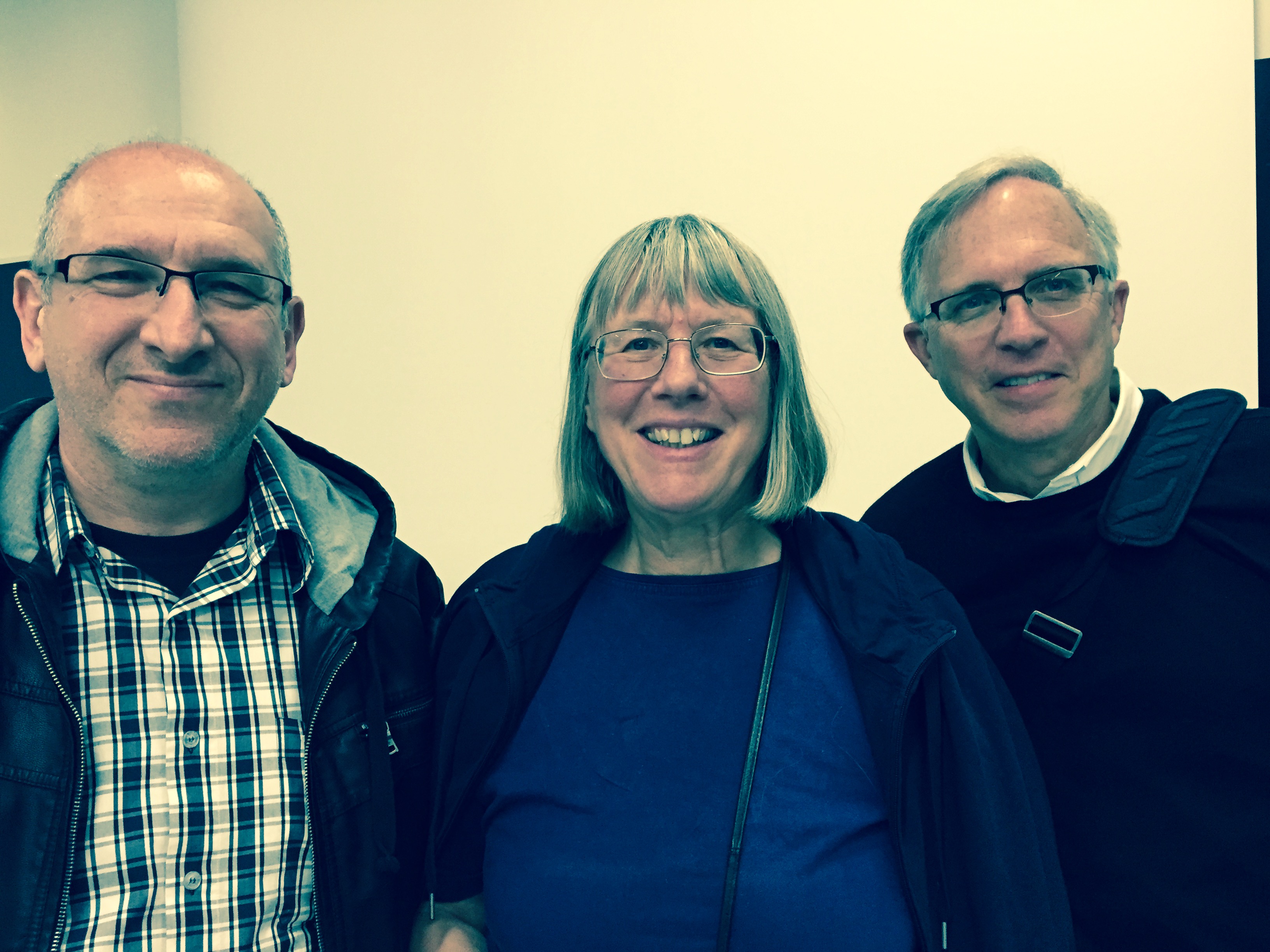
Mary at a Sept 2015 workshop in Berlin with event hosts Michel Bauwens and David Bollier. The event was sponsored by the Heinrich Böll Foundation and wascalled “Deep Dive: Capital for the Commons.”
Predictions are that we will soon be seeing the “nuclear option” — central bank-created money injected directly into the real economy. All other options having failed, governments will be reduced to issuing money outright to cover budget deficits. So warns a September 18 article on ZeroHedge titled “It Begins: Australia’s Largest Investment Bank Just Said ‘Helicopter Money’ Is 12-18 Months Away.”
Money reformers will say it’s about time. Virtually all money today is created as bank debt, but people can no longer take on more debt. The money supply has shrunk along with people’s ability to borrow new money into existence. Quantitative easing (QE) attempts to re-inflate the money supply by giving money to banks to create more debt, but that policy has failed. It’s time to try dropping some debt-free money on Main Street. Continue reading →
Capitalism is often touted as the most dynamic marketplace performer capable of lifting more boats faster than any other — but why then do we see its colossal failures as a stable and equitable driver of well-being for the vast majority of its practitioners? Ellen speaks with one of the most knowledgeable experts on economic systems, Dr. Richard Wolff, about how capitalism fails in part because of its anti-democratic underpinnings that rock many of those boats and swamp others while letting the captains of capital cruise on. We also talk about the emerging popularity of Quantitative Easing for the People and the importance of values-driven common cause for change.
“No flow, no go.” That may be the simplest way to describe the critical role of central banks to the flow of credit and money into any monetary system. It was the lack of access to cash and bank liquidity that humbled Greece, Detroit and others. Ellen speaks with Dr. Timothy Canova, one of the foremost experts on our central bank, the Federal Reserve, about why their operation of our cash spigot determines who wins and who loses.
Is the financial deprivation of entire nations engendering a new level of frustration and political unrest? Are the unlikely top-ranked US presidential candidates a sign that the Europeans aren’t the only ones who want to “throw the bums out?” These emerging political themes are the subject of It’s Our Money, as Ellen engages renowned author, advisor and economics professor Michael Hudson, just back from his consultations with Greece’s Syriza party. Archivedhere.
Mark Anielski and I spoke on a panel following Herman Daly’s plenary address on “Ecological Economics for an Ecological Civilization,” at an international conference called SEIZING AN ALTERNATIVE: Toward an Ecological Civilization, held on the campus of Pomona College, Claremont, CA June 4-7, 2015. John B. Cobb, Jr. also joined Daly’s plenary discussion. Mark is at 1:02:25 and I’m at 1:10:36 on the ticker.
“My father made him an offer he couldn’t refuse. Luca Brasi held a gun to his head and my father assured him that either his brains, or his signature, would be on the contract.” — The Godfather (1972)
In the modern global banking system, all banks need a credit line with the central bank in order to be part of the payments system. Choking off that credit line was a form of blackmail the Greek government couldn’t refuse.
Former Greek finance minister Yanis Varoufakis is now being charged with treason for exploring the possibility of an alternative payment system in the event of a Greek exit from the euro. Continue reading →
It isn’t just the Greeks, or the Cypriots, or the Irish, or the Icelanders suffering the price of financial terrorism – the extractive demands of global central banks on display in Greece are actively draining the marrow of impoverished communities the world over. Ellen speaks with author and expert Stephen Lendman about the financial powers forcibly overruling Greek democracy, and their intentions to do so everywhere. Co-host Walt McRee speaks with an official of one California county government pushing back against convicted bank felons, and later discusses new human evolutionary awareness about our relationship with money with philosopher Robert Bows. And Matt Stannard discusses our myths about “the Great American Entrepreneur” on the Public Banking Report.
The crushing Greek debt could be canceled the way it was made – by sleight of hand. But saving the Greek people and their economy is evidently not in the game plan of the Eurocrats.
Greece’s creditors have finally brought the country to its knees, forcing President Alexis Tsipras to agree to austerity and privatization measures more severe than those overwhelmingly rejected by popular vote a week earlier. No write-down of Greece’s debt was included in the deal, although the IMF has warned that the current debt is unsustainable.
There are many reasons to keep our focus on Greece — self-interest being one. Dr. Paul Craig Roberts returns to disclose the backstory of the political-bankster collaboration that has brought Greece to its knees and threatens economies the world over, including ours. Ellen suggests a solution for how the Greeks can proceed from here. Matt Stannard takes a historical look at German/Greek finances and we discuss the important leadership of Pope Francis’ review of what’s really important in any economy. Hint: it’s not about your wallet.
Banks create money when they make loans. Greece could restore the liquidity desperately needed by its banks and its economy by nationalizing the banks and issuing digital loans backed by government guarantees to its ailing businesses. Greece could provide an inspiring model of sustainable prosperity for the world. But it is being strangled by a hegemonic power in a financial war that is being waged against us all.
On July 4, 2015, one day before the national vote on the austerity demands of Greece’s creditors, it was rumored in the Financial Times that Greek banks were preparing to “bail in” (or confiscate) depositor funds to replace the liquidity choked off by the European Central Bank.
The response of the Syriza government, to its credit, was “no way.” As reported in Zerohedge, the government was prepared to pursue three “nuclear options” to protect the deposits of the Greek people: Continue reading →
Pope Francis’ revolutionary encyclical addresses not just climate change but the banking crisis. Interestingly, the solution to that crisis may have been modeled in the Middle Ages by Franciscan monks following the Saint from whom the Pope took his name.
Pope Francis has been called “the revolutionary Pope.” Before he became Pope Francis, he was a Jesuit Cardinal in Argentina named Jorge Mario Bergoglio, the son of a rail worker. Moments after his election, he made history by taking on the name Francis, after Saint Francis of Assisi, the leader of a rival order known to have shunned wealth to live in poverty.
Pope Francis’ June 2015 encyclical is called “Praised Be,” a title based on an ancient song attributed to St. Francis. Most papal encyclicals are addressed only to Roman Catholics, but this one is addressed to the world. And while its main focus is considered to be climate change, its 184 pages cover much more than that. Among other sweeping reforms, it calls for a radical overhaul of the banking system. It states in Section IV: Continue reading →
Anchorman Howard Beale’s outburst that mobilized a nation to scream out their windows in anger at the tyranny of the powers-that-be makes an apt sequel to this week’s news that Fast Track approval of the TPP appears imminent. Ellen speaks with Kevin Zeese, the foremost leader of national citizen’s campaigns pushing back against the obvious collusion of government leaders and corporate interests. It will have you heading toward your own windows. Co-host Walt McRee speaks with Chuck Watts of the Empathy Surplus Project about the power of language in creating the new economy and a new generation of public policy, while Matt Stannard reflects on Wells Fargo’s recent efforts at impacting social justice.
Listen at noon pst/3 pm est here or archived thereafter here.
It is well enough that the people of the nation do not understand our banking and monetary system, for if they did, I believe there would be a revolution before tomorrow morning. — Attributed to Henry Ford
In March 2014, the Bank of England let the cat out of the bag: money is just an IOU, and the banks are rolling in it. So wrote David Graeber in The Guardian the same month, referring to a BOE paper called “Money Creation in the Modern Economy.” The paper stated outright that most common assumptions of how banking works are simply wrong. The result, said Graeber, was to throw the entire theoretical basis for austerity out of the window.
The revelation may have done more than that. The entire basis for maintaining our private extractive banking monopoly may have been thrown out the window. And that could help explain the desperate rush to “fast track” not only the Trans-Pacific Partnership (TPP) and the Trans-Atlantic Trade and Investment Partnership (TTIP), but the Trade in Services Agreement (TiSA). TiSA would nip attempts to implement public banking and other monetary reforms in the bud. Continue reading →
On June 4-7, 2015, we aim to create Pandomonium! “Seizing an Alternative: Toward an Ecological Civilization”
“Seizing an Alternative: Toward an Ecological Civilization”focuses on the big ideas that matter for a thriving ecosphere, featuring some seven hundred presenters and more than eighty areas of specialty. For details, see here. And to hear about it, listen to founder Dr. John Cobb interviewed on “It’s Our Money with Ellen Brown”, here.
The dangerous underfunding of US infrastructure was underscored by a fatal train derailment on May 12th. The tragedy did not deter the House Appropriations Committee from voting to slash Amtrak funding the very next day. There are ways Congress could fund its massive infrastructure bill without raising taxes. But the conservative-controlled Congress seems to have other plans for the nation’s profitable public assets. Continue reading →
In the world of monetary reformists, there’s a clear understanding that things not only shouldn’t continue as they are, they can’t continue as they are – that systemic failure is upon us as current social and political outcomes tear at the fabric of civil life. Ellen speaks with Gar Alperovitz, one of America’s most venerable reformist thinkers and policy experts, about his new “The Next System Project” to help design and precipitate what should happen next. Also, maybe the national debt is unnecessary after all – author Scott Baker talks with co-host Walt McRee about his new book “America is Not Broke,” and Matt Stannard reports on the financial travesties imposed by Wall Street on American cities.
1176. 10-22-23, 10:45 am, speaker, The Weston A. Price Foundation’s 23rd Annual Conference, Kansas City, Missouri.
1175. 10-19-23, The Final Banking Solution, with Simon Thorpe and Colin Maxwell on The Vinny Eastwood Show, YouTube, Australia.
1174. 8-22-23, 10 am, Claremont, CA, Cobb Institute Center for Process, power point presentation: “Restoring Prosperity with a Financial Transaction Tax and Publicly Owned Banks.“ Zoom link is here.
1173. 6-15-23, NIB Zoom town hall, National Infrastructure Bank Coalition.
1172. 5-22-23: Radio interview, 9:30 am est, The Power Hour.
1171. 5-17-23: TV interview, CGTN America, Global Business: “Banking industry in hot seat during Congressional hearings.”
1170. Apr 27, National Infrastructure Bank Coalition webinar, “How to Build the Nation: National Banking vs. Privatization”
1160. 3-16-23, 5 pm pst, National Infrastructure Bank Coalition Town Hall, “Restructuring the American Workforce in a Time of Financial and Economic Turbulence.”
1156. 2-25-23, 15:00-17:00 GMT (Ireland), Think Local Conference 2023, Panel 3 – Money & Economics – New Paradigms
1155. 2-16-23, 5 pm pst, National Infrastructure Bank Coalition, “Washington, Hamilton, Lincoln: National Banking and the Economic Demands of Today’s Crisis,” NIB Zoom Town Hall
1130. Mar. 31, Power Point presentation on youtube, Universidad Nacional de Colombia, Invita: Debates Ensayos de Economia Coordina: Guillermo Maya — Profesor adscrito al Departamento de Economia
1115. Feb. 23, 7 pm est, Eco Justice Collaborative Webinar, “Why the Crises We Face Make Financial Reform Essential,” Religious Society of Friends, Philadelphia
1114. Feb. 17, 11 am, Steff Overbeck, Pod of Gold radio interview
1113. Feb. 18, radio interview, Phil Mikan, wlis1420
1112. Feb. 16, National Infrastructure Bank Coalition Presidents’ Day Webinar 2021 – “National Infrastructure Bank: Standing on the Shoulders of Giants”
1111. Feb. 6, radio interview, Sylvia Richardson, Latin Waves
1097. Oct. 26, Phil Mikan Show, WLIS/WMRD Radio, Conn., pre-recorded for Friday at 10 est or Saturday at 9-11 est
1096. Oct. 22, 1:15 pm EST, power point presentation, “Public Banking, Modern Monetary Theory (MMT) and the National Debt,” Carolina Hills Community, Chapel Hill, NC
1088. July 15, 6 pm EST, Connecticut Public Banking Town Hall, livestream here
1087. July 13, Webinar, Center for Global Justice, “Why Public Banking Needs to Be Run as a Public Utility,” San Miguel de Allende, Mexico, 11am-1pm PDT
1086. Interview with Susan Johnson on public banking for Connecticut, WILI’s Let’s Talk About It Show, 5 pm EST
1044. Nov. 12, interview in New York with Max Keiser, Keiser Report, “Repo Markets and UBI”
1043. Nov. 6, 5 pm EST, The CivicLab Show with Tom Tresser, live@www.facebook.com/tomtree
1042. Oct. 23, 11:30 am-1:30 pm, luncheon presentation on public banking, League of Women Voters of San Diego, Tom Ham’s Lighthouse Restaurant, 2150 Harbor Island Dr., San Diego
1041. Oct. 22, Presentation on public banking, DSA San Diego, Unite Here Union Hall, 2436 Market Street, San Diego, 6-7:30 pm.
1006. Oct. 22, speaker with Gar Alperovitz at Praxis Peace Institute, “Changing the System: California’s Strategic Role in National Strategic Change,” Sonoma, CA, 276 E. Napa St, Sonoma. 7:00 pm.
1005. Oct 19-21, Bioneers Conference, panelist on Oct 20, 2:45 pm, Marin Center, San Rafael, CA.997.
999. Oct. 7, panel, Americans for Democratic Action of Southern California Annual Garden Party, 2-5:30 pm, Santa Monica, CA
998. Oct. 4, 7:30 pm, Living Economy Salon, panelist, Public Bank LA: “Solutions for Social and Environmental Justice”, 3110 Main St., Annex Building C 2nd Floor, Santa Monica, CA 90405
997. Oct. 3, interview on Unmediated, podcast of Reader Magazine, episode title: Making Money The Public’s Slave (The Public Banking Solution), 10 a.m. PT




 WEB OF DEBT BLOG
Time for the Nuclear Option: Raining Money on Main Street
Predictions are that we will soon be seeing the “nuclear option” — central bank-created money injected directly into the real economy. All other options having failed, governments will be reduced to issuing money outright to cover budget deficits. So warns a September 18 article on ZeroHedge titled “It Begins: Australia’s Largest Investment Bank Just Said ‘Helicopter Money’ Is 12-18 Months Away.”
Money reformers will say it’s about time. Virtually all money today is created as bank debt, but people can no longer take on more debt. The money supply has shrunk along with people’s ability to borrow new money into existence. Quantitative easing (QE) attempts to re-inflate the money supply by giving money to banks to create more debt, but that policy has failed. It’s time to try dropping some debt-free money on Main Street. Continue reading →
Filed under: Ellen Brown Articles/Commentary | Tagged: Jeremy Corbyn, money creation, public banking, quantitative easing | 36 Comments »