Compound Interest Is Devouring the Federal Budget: It’s Time to Take Back the Money Power

Albert Einstein is often quoted as saying that compound interest is “the most powerful force in the universe.” The quote is probably apocryphal, but it reflects a mathematical truth. Interest on earlier interest grows exponentially, outrunning the linear growth of revenue and eventually consuming everything.

That is where the United States now stands. The government does pay the interest on its debt every year, but it is having to pay it with borrowed money. The interest curve is rising exponentially, while the tax base is not.
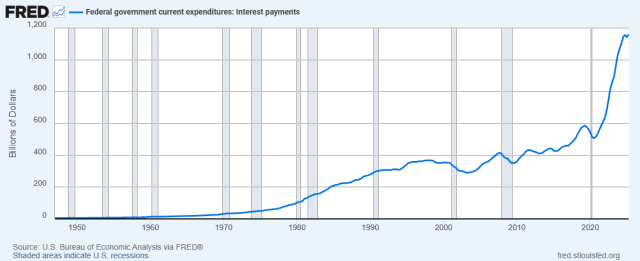
Interest is now the fastest growing line item in the entire federal budget. The government paid $970 billion in net interest in FY2025, more than the Pentagon budget and rapidly closing in on Social Security. It already exceeds spending on Medicare and national defense and is second only to Social Security. The Congressional Budget Office projects that interest will reach nearly $1.8 trillion by 2035 and will cost taxpayers $13.8 trillion over the next decade. That is roughly what Social Security will pay out over the same decade (about $1.6 trillion a year). The Social Security Trust Fund is running dry, not because there are too many seniors, but because interest payments are consuming the federal budget that should be shoring it up.

Continue reading

The GENIUS Act and the National Bank Acts of 1863-64: Taking a Cue from Lincoln

This month Congress passed the GENIUS Act, an acronym for the “Guiding and Establishing National Innovation for U.S. Stablecoins of 2025.” Designed to regulate stablecoins, a category of cryptocurrency designed to maintain a stable value, the Act is highly controversial. 

Critics variously argue that it anoints stablecoins as the equivalent of “programmable” central bank digital currencies (CBDCs), that it lacks strong consumer protections, and that government centralization destroys the independence of the cryptocurrency market. Proponents say the rapidly expanding stablecoin market not only provides a faster and cheaper payments system but can serve as a major funding source to help alleviate the federal debt crisis, which is poised to destroy the economy if not checked, and that the stablecoin market has gotten so large that without regulation, we may have to bail it out when it becomes a multitrillion dollar industry that is “too big to fail.”

For most people, however, the whole subject of stablecoins is a mystery, so this article will attempt to throw some light on it. It will also explore some historical use cases demonstrating how the government might incorporate stablecoins into a broader program for escaping the debt crisis altogether.

Continue reading

Why Public Funds Should Be Deposited in Publicly-Owned Banks

Credit to JustMoney.com for the image, editing and posting.

A thriving economy requires that credit flow freely for productive use. But today, a handful of giant banks diverts that flow into an exponentially-growing self-feeding pool of digital profits for themselves. Rather than allowing the free exchange of labor and materials for production, our system of banking and credit has acted as a tourniquet on production and a drain on resources.

Yet we cannot do without the functions banks perform; and one of these is the creation of “money” as dollar-denominated bank credit when they make loans. This advance of credit has taken the form of “fractional reserve” lending, which has been heavily criticized. But historically, it is this sort of credit created on the books of banks that has allowed the wheels of industry to turn. Employers need credit at each stage of production before they have finished products that can be sold on the market, and banks need to be able to create credit as needed to respond to this demand. Without the advance of credit, there will be no products or services to sell; and without products to sell, workers and suppliers cannot get paid.

Bank-created deposits are not actually “unbacked fiat” simply issued by banks. They can be created only when there is a borrower. In effect, the bank has monetized the borrower’s promise to repay, turning his promise to pay tomorrow into money that can be spent today — spent on the workers and materials necessary to create the products and services that will be sold to repay the loans. As Benjamin Franklin wrote, “many that understand Business very well, but have not a Stock sufficient of their own, will be encouraged to borrow Money; to trade with, when they have it at a moderate interest.”

If banks have an unfair edge in this game, it is because they have managed to get private control of the credit spigots. They have often used this control not to serve business, industry, and society’s needs but for their private advantage. They can turn credit on and off at will, direct it at very low interest to their cronies, or use it for their own speculative ventures; and they collect the interest as middlemen. This is not just a modest service fee covering costs. Interest has been calculated to compose a third of everything we buy.

Continue reading here.

McKinley or Lincoln? Tariffs vs. Greenbacks

President Trump has repeatedly expressed his admiration for Republican President William McKinley, highlighting his use of tariffs as a model for economic policy. But critics say Trump’s tariffs, which are intended to protect U.S. interests, have instead fueled a stock market nosedive, provoked tit-for-tat tariffs from key partners, risk a broader trade withdrawal, and could increase the federal debt by reducing GDP and tax income. 

The federal debt has reached $36.2 trillion, the annual interest on it is $1.2 trillion, and the projected 2025 budget deficit is $1.9 trillion – meaning $1.9 trillion will be added to the debt this year. It’s an unsustainable debt bubble doomed to pop on its present trajectory. 

The goal of Elon Musk’s DOGE (Department of Government Efficiency) is to reduce the deficit by reducing budget expenditures. But Musk now acknowledges that the DOGE team’s efforts will probably cut expenses by only $1 trillion, not the $2 trillion originally projected. That will leave a nearly $1 trillion deficit that will have to be covered by more borrowing, and the debt tsunami will continue to grow.

Rather than modeling the economy on McKinley, President Trump might do well to model it on our first Republican president, Abraham Lincoln, whose debt-free Greenbacks saved the country from a crippling war debt to British-backed bankers, and whose policies laid the foundation for national economic resilience in the coming decades. Just “printing the money” can be and has been done sustainably, by directing the new funds into generating new GDP; and there are compelling historical examples of that approach. In fact, it may be our only way out of the debt crisis. But first a look at the tariff issue.

Continue reading

Beating Wall Street at Its Own Game — The Bank of North Dakota Model

North Dakota is staunchly conservative, having voted Republican in every presidential election since Lyndon Johnson in 1964. So how is it that the state boasts the only state-owned bank in the nation? Has it secretly gone socialist?

No. The Bank of North Dakota (BND) operates on the same principles as any capitalist bank, except that its profits and benefits serve the North Dakota public rather than private investors and executives. The BND provides a unique, innovative model, in which public ownership is leveraged to enhance the workings of the private sector. It invests in and supports private enterprise — local businesses, agriculture, and economic development – the core activities of a capitalist system where private property and enterprise are central. Across the country, small businesses are now failing at increasingly high rates, but that’s not true in North Dakota, which was rated by Forbes Magazine the best state in which to start a business in 2024. 

The BND was founded in 1919, when North Dakota farmers rose up against the powerful out-of-state banking-railroad-granary cartel that was unfairly foreclosing on their farms. They formed the Non-Partisan League, won an election, and founded the state’s own bank and granary, both of which are still active today.

The BND operates within the private financial market, working alongside private banks rather than replacing them. It provides loans and other banking services, primarily to other banks, local governments, and state agencies, which then lend to or invest in private sector enterprises. It operates with a profit motive, with profits either retained as capital to increase the bank’s loan capacity or returned to the state’s general fund, supporting public projects, education, and infrastructure.

According to the BND website, more than $1 billion had been transferred to the state’s general fund and special programs through 2018, most of it in the previous decade. That is a substantial sum for a state with a population that is only about one-fifteenth the size of Los Angeles County.  

The BND actually beats private banks at their own game, generating a larger return on equity (ROE) for its public citizen-owners than even the largest Wall Street banks return to their private investors. 

Continue reading

Defusing the Derivatives Time Bomb: Some Proposed Solutions

The “protected class” is granted “safe harbor” only because their bets are so risky that to let them fail could crash the economy. But why let them bet at all?

This is a sequel to a Jan. 15 article titled “Casino Capitalism and the Derivatives Market: Time for Another ‘Lehman Moment’?”, discussing the threat of a 2024 “black swan” event that could pop the derivatives bubble. That bubble is now over ten times the GDP of the world and is so interconnected and fragile that an unanticipated crisis could trigger the collapse not just of the bubble but of the economy. To avoid that result, in the event of the bankruptcy of a major financial institution, derivative claimants are put first in line to grab the assets — not just the deposits of customers but their stocks and bonds. This is made possible by the Uniform Commercial Code, under which all assets held by brokers, banks and “central clearing parties” have been “dematerialized” into fungible pools and are held in “street name.”

This article will consider several proposed alternatives for diffusing what Warren Buffett called a time bomb waiting to go off. That sort of bomb just detonated in the Chinese stock market, contributing to its fall; and the result could be much worse in the U.S., where the stock market plays a much larger role in the economy.

Continue reading

The Looming Quadrillion Dollar Derivatives Tsunami

On Friday, March 10, Silicon Valley Bank (SVB) collapsed and was taken over by federal regulators. SVB was the 16th largest bank in the country and its bankruptcy was the second largest in U.S. history, following Washington Mutual in 2008. Despite its size, SVB was not a “systemically important financial institution” (SIFI) as defined in the Dodd-Frank Act, which requires insolvent SIFIs to “bail in” the money of their creditors to recapitalize themselves.

Technically, the cutoff for SIFIs is $250 billion in assets. However, the reason they are called “systemically important” is not their asset size but the fact that their failure could bring down the whole financial system. That designation comes chiefly from their exposure to derivatives, the global casino that is so highly interconnected that it is a “house of cards.” Pull out one card and the whole house collapses. SVB held $27.7 billion in derivatives, no small sum, but it is only .05% of the $55,387 billion ($55.387 trillion) held by JPMorgan, the largest U.S. derivatives bank.

Continue reading

Two power points: “A Deep Dive into Money and Banking” and “Funding the Green Transition with Public Banks”

http://https://www.youtube.com/watch?v=z8P7tnC4w0s

_______________________________________________________________________________________________________________

http://https://www.youtube.com/watch?v=gliik0ve8eg